


His Excellency Chinese Ambassador, Always remember Nepal is a "Democratic" nation!

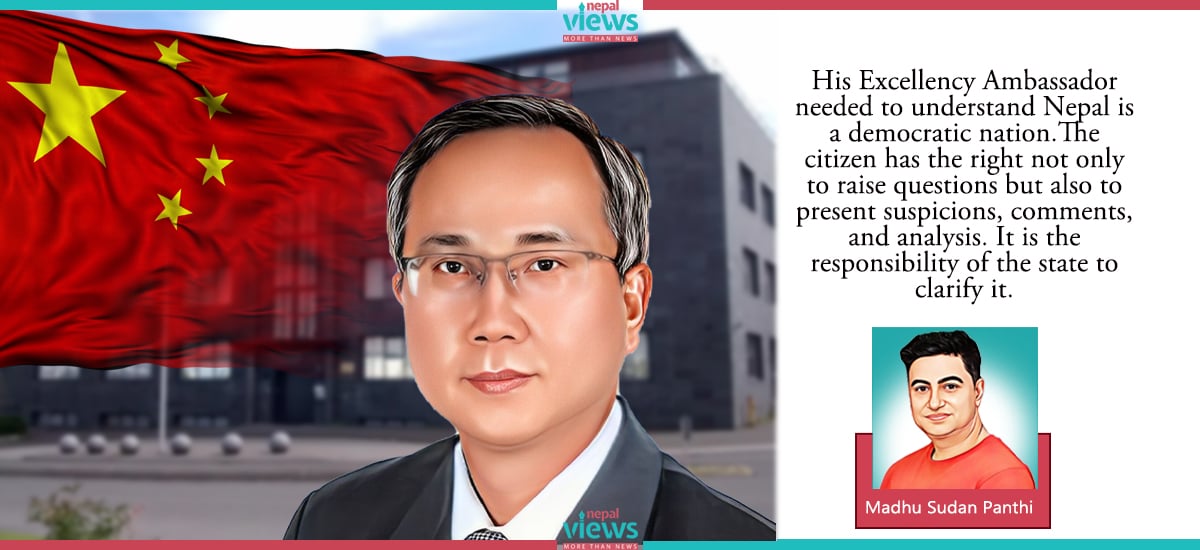

Kathmandu: Chinese Ambassador to Nepal Chen Song's warning to Journalist Gajendra Budhathoki, through social media, has drawn special attention for discussion. It is not practical for an Ambassador of any neighboring friendly nation to unnecessarily get agitated when a journalist of a democratic nation is fulfilling responsibility by communicating information regarding the national matter and utilizing the fundamental right of the freedom of expression.
Possibly, no such case has previously been reported in the history of Nepal's diplomatic relations.
Journalist Budhathoki raised a question regarding the interest loan rate in the construction of the Pokhara International Airport, on social media platform X, which comprises Chinese investment. Budhathoki expressed his suspicion about the Pokhara Airport's loan interest rates, being 5% rather than 2% when the ownership was transferred to the Civil Aviation Authority of Nepal (CAAN). The comment was Budhathoki's 'suspicion' rather than being a 'claim.' And it was concerned with the Government of Nepal, not with the Chinese Embassy.
This question was connected with the Nepali National and the state. There was no need for the Chinese Ambassador to enter in the middle and make unnecessary comments.
His Excellency Ambassador needed to understand Nepal is a democratic nation. The question-answer between the citizen and the state regarding matters of public significance is quite common in democratic nations. The citizen has the right not only to raise questions but also to present suspicions, comments, and analysis. It is the responsibility of the state to clarify it.
The Government of Nepal has already criticized the Chinese claim regarding the investment format of the Pokhara Airport. Chinese have been claiming the construction of the Pokhara International Airport of being under the Belt and Road Initiative (BRI) project. And Nepal has been disagreeing with the statement of China.
The agreement of the primitive investment in the Pokhara Airport was done in 2012 A.D. And Nepal signed the BRI agreement only in 2017. Even from the simple legal validity, there is no doubt of the Chinese statement being wrong.
It is not understandable why a huge economic and emerging world power, like China, is trying to increase disagreement with a small neighboring nation like Nepal.
It is a matter of public debate whether Nepal to take the loan at a high-interest rate or not, and every Nepali national has the right to participate in it. Journalist Budhathoki utilized that right while expressing his opinion.
After the fiscal year 2016/17 (2073/074), the public debt has abnormally risen in the past decade. The public debt was around 7 trillion. But within 7 years, it increased by more than 3 times and reached 24 trillion. This is a matter of concern for every Nepali national. Journalist Budhathoki expressed the same concern in his suspicion.
The abnormality of the plague of debt is visible in Nepal's economy and annual budget. In the past 2 fiscal years, the financial expenses were predicted to be only near 10/12 percent. And the Capital Expenditure ratio used to be more than the financial expenses.
However, after the fiscal year 2023/024 (2080/81), this trend was overturned. The finance expenditure reached 17.55% when the Capital Expenditure was 17.25%. It has been predicted that the number will even rise more to 19.76% in the upcoming fiscal year. This means the obligation of state debt and principal-interest payments will skyrocket.
Likewise, Nepal is reaching the condition of taking another loan to clear the previous loan. Economic crisis, financial imbalance, and entrepreneurial decline have destroyed the life of Nepali society. Nepali nationals, not only possess the right to show concern towards the economy of the nation, it is also our constitutional duty.
His Excellency Ambassador might have objections or restlessness about spreading inappropriate illusions regarding Chinese loans. But, in the name of countermeasures, there is no need to step forward in social media to give a warning on a personal level.
Moreover, an Embassy can issue a diplomatic press statement to address the complaints raised by the Nepali public. Despite having such a convenient way, His Excellence Ambassador's impolite dealing through social media is against the protocol of diplomacy.
His Excellency Chinese Ambassador needs to understand is that the 2% interest loan itself is too expensive for Nepal. Nepal has not paid such an expensive interest loan rate to any other donor nation or international institution other than China. China is not the last alternative left for Nepal to take a loan. Despite having the alternative of choosing convenient or zero loan interest sources, Nepal is not obliged to take loans at high interest rates.
The implementation of the BRI project is failing even after seven years of its agreement due to the investment format. Nepali nationals are quite aware of the huge pressure on Nepal to implement the expensive loan investment format; the BRI project. That was the reason behind not implementing the scheduled BRI agreement during the China visit of Foreign Affairs Minister Narayan Kaji Shrestha.
The Nepali public is aware of the story of Sri Lanka's Hambantota. Just like Sri Lanka, Nepali nationals do not want to commit the mistake of taking expensive loans to build projects that have no return and being compelled to hand over certain lands on lease to China in case of not being able to make payments of the principal interest. Sovereign Nepali National cannot even imagine such situations.
Pokhara Airport itself has proved to be a hotspot for Nepal. On the one hand, even after a year and a half of the airport's operation, there are no international flights. On the other hand, the Commission for the Investigation of the Abuse of Authority (CIAA) is investigating irregularities and corruption in the construction works involving Chinese companies.
Understanding this, it is difficult to understand why China is putting pressure on Nepal for high-interest rate loans.
Nepal has its geopolitical complexities. Nepal cannot pay the price of its relations with the rest of the world for the approval and convenience of the Chinese approach.
China needs to understand very well that China should be ready for grants, zero interest rates, or long-term loans with interest rates below 1 percent, otherwise, BRI will not be implemented in Nepal even if there is an agreement. Nepalese citizens expect that this reality should be understood by the Chinese side.
In a democratic state, everything does not happen according to the will of the ruler or state administrator. Consensus of citizens is also needed. If the country is plunged into a 'debt trap' by borrowing at high interest rates, no one here can stay in the government.
If Nepal has complaints and objections from the Chinese Embassy, it can take them to the government and the Ministry of Foreign Affairs. His Excellency the ambassador doesn't need to come to social media to seek force on a personal level with citizens.
This kind of behavior is not expected from the Chinese Ambassador in Nepal and was not done. China was considered a civilized, calm, silent, and dignified diplomatic nation for Nepal until the previous decade. However, in the last few years, China has been losing this image. This should be a matter of concern for China itself.
Suspicion has increased that China has begun to move towards aggressive and micro-management diplomacy in Nepal. Especially after the general election of 2017 (2074), communist unity, almost two-thirds of the government of the left-wing coalition, instead of 'state-state cooperation', it seems that the mentality of 'communist-communist cooperation' is becoming dominant. This is a harmful approach and practice for the long-term future of Nepal-China relations.
His Excellency the Ambassador has asked the journalist Budhathoki to "apologize". Nepal is under the sovereignty of Nepali citizens. The Chinese Embassy does not have the right to issue orders to Nepali citizens for any actions or expressions that have taken place inside Nepal. This is also contrary to normal diplomatic etiquette.
The Ministry of Foreign Affairs of Nepal must take cognizance of the threat to journalist Budhathoki and make necessary inquiries with the Chinese Embassy.