


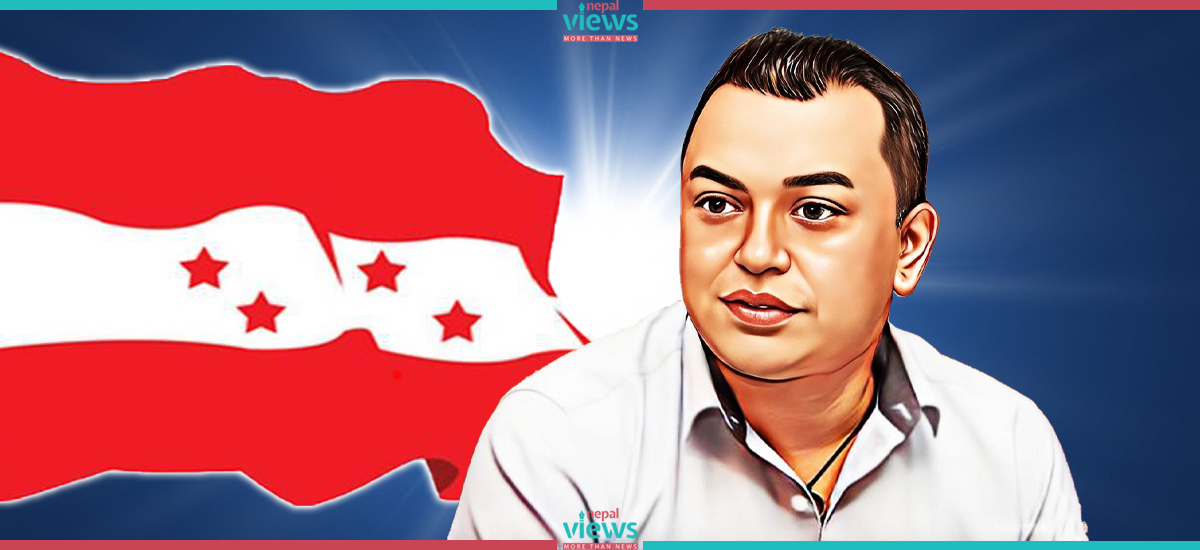
The problem of being Gagan Thapa
The current Congress crisis is rooted in systemic flaws in the party, and it is also a test for the firebrand general secretary, who often vacillates between accommodation and confrontation.

NRNHub
01/05/2026 12:15 PM EST7 min read

Kathmandu: For a party that calls itself democratic, the Nepali Congress has a long-standing habit: it delays leadership renewal. Take, for example, the following instances from the last two decades.
Since 2001, every General Convention has come late.
The 10th General Convention was held on January 19–23, 2001; the 11th on August 17–20, 2005 — a gap of more than four years and six months.
The 12th took place on September 17–21, 2010— after five years and a month.
The 13th came on March 3–6, 2016— once again after more than five years.
The 14th was delayed more than five years, convening only on December 13–15, 2021, with Covid-19 partly to blame.
This is not an aberration. It is a pattern.
Had it not been for the September 2025 Gen Z movement, the Nepali Congress would not have begun its convention preparations even today. That in itself says much about how seriously the party treats its own statute.
In the past 20 years, the Nepali Congress has repeatedly failed to adhere to the provision that requires it to hold its General Convention — a core democratic exercise — every four years. Instead, it has normalised the use of “special provisions” to extend leadership terms, turning what was meant to be an exception into a governing principle.
Since Sher Bahadur Deuba is a beneficiary of this arrangement lately, it would not be wrong to assume that he had no plans to stick to the four-year statutory provision the day he was elected party president in 2021.
When Deuba took over the party’s reins from the last convention, he was already serving his second — and last — term. And had the Gen Z protests not intervened, there is little reason to believe he would not have exploited not just the statutory “special-circumstances” provision but also the constitutional loophole to extract a further six-month extension beyond even the five-year cycle.
For a leader, a year shy of 80, nearing the end of his political career, prolonging control most likely would have taken precedence over institutional renewal, given that in recent years his politics is inclined more towards personal ambitions.
But Deuba’s dominance does not exist in a vacuum.
If the Gen Z protests had not happened, would General Secretary Gagan Thapa have demanded an early convention? Wasn’t he faithfully toeing Deuba’s line all along?
Despite publicly declaring that Congress would remain in opposition until the next elections, Thapa went on to support the party president’s politically unnatural deal with UML chairman KP Sharma Oli. Deuba had, in fact, blindsided him — signing the agreement in July 2024 without his knowledge — yet Thapa chose accommodation over confrontation.
Setting his sights on the party presidency from the 15th convention, Thapa was in no hurry for an early convention, let alone a timely convention (within four years). He was busy working within an unconstitutional political framework — an idea he had once opposed — to make the Oli government successful at any cost. In line with the Deuba–Oli deal, he was waiting for his party president’s next ascent to Singha Durbar. In effect, he traded timely institutional renewal for short-term political positioning — a choice with consequences the party now faces.
Then the youth protests shook Nepal’s political order and altered the political equation altogether. Oli was ousted. Deuba was beaten up at his home.
A month after the protests, Deuba appointed party Vice-President Purna Bahadur Khadka as acting party president. Many read this as a signal of his retreat from active politics. As it has now become apparent, that reading proved premature. When Deuba left for Singapore, Congress — under the pretext of convening a Central Committee meeting — haggled for a month, failing to reach a resolution. The Thapa-led faction pushed for a convention before the March 5 vote; the Deuba-backed establishment side pushed back.
Upon his return, Deuba re-stamped his control. He dismissed the demand for a special convention, even though more than 50 percent of general convention representatives had signed for it. Through a recent meeting, he secured an extension of his term until mid-May and had the party “officially” decide to hold its 15th General Convention on May 11–14. This was not just a procedural manoeuvre; it was a demonstration of how internal dissent is managed — delayed, diluted, and overridden.
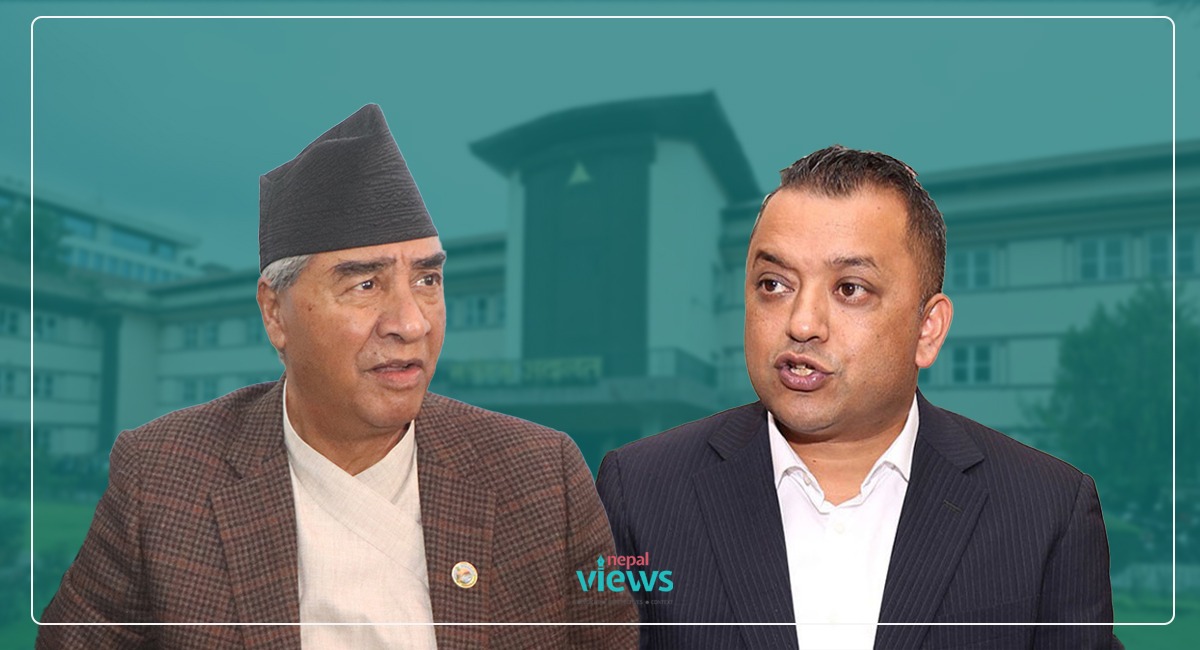
The dissident faction led by Thapa, backed by his fellow General Secretary Bishwo Prakash Sharma, has now called for a special convention on January 11–12. The crisis within Congress has deepened, and the party is staring at the possibility of a split.
There is a growing consensus — including in the media — that Deuba must go and Thapa should come in. The arguments for this transition are familiar. But the more important question is not who replaces whom, but what changes, and why — and an even bigger point is how.
That the spirit of the Gen Z movement is merely about generational change, including within political parties, is an overly generalised reading. The movement did force a reckoning; it exposed the cost of delay — both by those who refuse to relinquish power and by those who wait too long to challenge it. But reform is a process.
It is not to say that Deuba should stay, nor that he should immediately step aside to satisfy dissident demands. It is about consequence. If Congress has reached such a point of institutional exhaustion, Deuba, as party president, bears primary responsibility — but he does not bear it alone.
If Thapa discovered the urgency of generational change only after the street imposed it, questions must be asked of him as well. Leadership is tested not by crisis alone, but by foresight; acting only when forced reflects a failure of initiative. How did a leader branded as the face of youth politics remain so disconnected from the social undercurrents, the anger, and the frustration that eventually erupted? If the generation of leaders he represents only acts when forced, it has already failed part of its test.
And what further damage could Deuba still inflict if he remains at the helm for another five months?
At its core, the battle is over elections and ticket distribution. Deuba’s strength lies in his ability to marshal power and money to control candidate selection. The assumption is that, given the chance, he will make his own picks. This is not merely a personal failing; it is a systemic flaw that Congress has refused to confront and address.
Thapa’s problem is different but no less consequential. It’s true that he has been constrained by structural problems within his party, but these alone do not fully explain the situation; his repeated vacillations also need to be taken into account.
He is among the few leaders who admit their mistakes but often too late. Over time, this habit of delayed self-criticism has functioned less as accountability and more as insulation. In the short term, it earns praise; examined closely, it reveals indecision.
It would also be wrong to project Thapa entirely in a bad light, though. He has long played the role of opposition within his party. His road to the General Secretary post had not been easy. Yet, Congress over the years became such a mire that he got bogged down.
A little over four years ago, in the lead-up to the 14th General Convention, Thapa said that once he became General Secretary, the next convention would take place within four years — no ifs or buts, and no reliance on statutory, constitutional, or any other loopholes.
Now, his call for a special convention does not rest on that statement; it rather stems from the urgency he seems to have discovered after the youth movement.
Whether there will be a leadership change from Thapa group’s special convention or the establishment-declared regular May convention is for the party to decide. The ongoing dispute in Congress, however, is likely to have some impact on the party in the elections scheduled for March. The party alone is responsible for any outcome.
In that same speech, Thapa had said that once he became General Secretary, “Congress will not be asking questions; it will rather have answers.”
Today, it is Thapa who is asking questions — yet failing to extract answers from his party.
NRNHub
01/05/2026 12:15 PM EST7 min read
_LqGDyrjJvx.jpg)