


What’s in it for Bangladesh in the Kunming Trilateral?
As Dhaka joins a new regional dialogue with China and Pakistan, questions loom over unresolved history, uneven partnerships and the risks of strategic overreach.

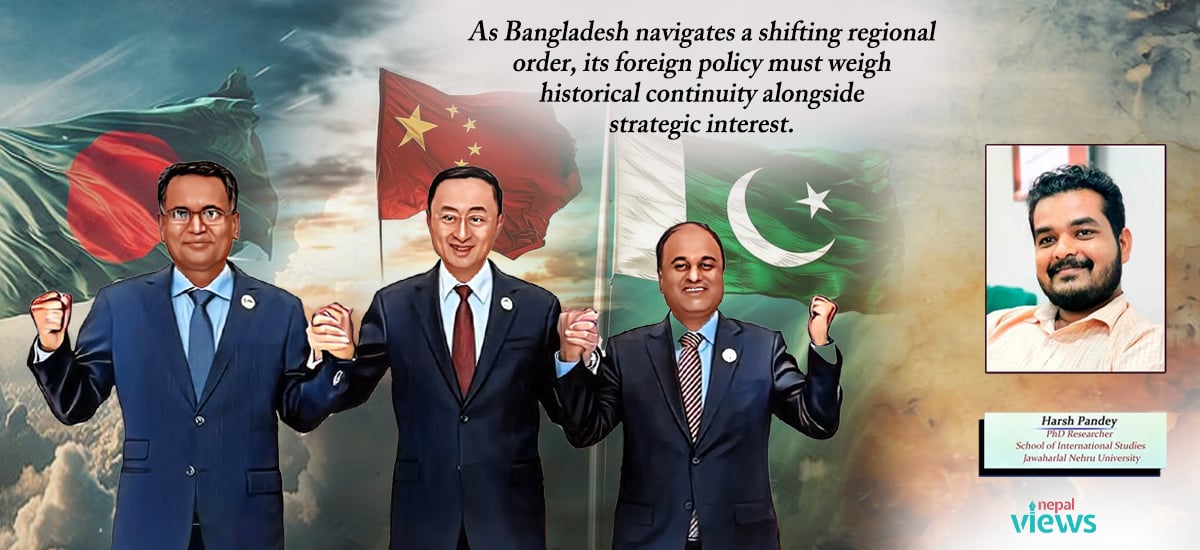

At first glance, the trilateral dialogue between China, Pakistan, and Bangladesh in Kunming on June 19, 2025, may seem like a natural step towards more regional connectivity and diplomatic diversity. The China–South Asia Exposition hosted the initiative, which was described as an informal way to promote “mutual understanding and cooperation.” It is the first structured trilateral engagement involving Dhaka with two long-aligned actors. The details, however, raise more questions than they answer, especially for Bangladesh, whose long-standing relationship with Pakistan remains unresolved, and whose growing dependence on China continues to shape its development path.
At the centre of this strategic equation is a break in history that has not yet been dealt with politically. Bangladesh's relationship with Pakistan is still constrained by the events of 1971, more than 50 years after it became an independent country. Three unresolved issues remain: Pakistan has not formally apologised for war crimes; about 300,000 Urdu-speaking Biharis, who were never repatriated, remain in limbo; and there is a longstanding dispute over pre-partition financial assets worth more than US$4.5 billion. These concerns are not merely symbolic, they are part of Bangladesh's national identity and the principles that have guided its statehood since independence. Their continued absence from high-level dialogue makes sustainable peace more difficult to achieve.
Bangladesh’s involvement in a three-way dialogue with Pakistan, without progress on these long-standing issues, marks a significant departure from past practice. Historically, Dhaka’s relationship with Islamabad has been shaped by careful balance: cooperation where necessary, but resistance to frameworks that separate material collaboration from moral redress. The Kunming format, by contrast, appears to do exactly that. It emphasises trade, connectivity and regional stability as future avenues for cooperation, while leaving history off the table. This kind of approach might boost Bangladesh’s foreign policy visibility in the short term, but it risks weakening narrative coherence and creating tensions between public memory at home and diplomatic actions abroad.
Even from an economic standpoint, the material incentives of the trilateral don’t seem particularly strong. Trade between Bangladesh and Pakistan remains limited, with only $700 million exchanged in FY 2023–24. The reopening of direct shipping routes has marginally improved logistics, but has not shifted the structural imbalance in trade, which continues to heavily favour Pakistan. As both countries are major textile exporters targeting similar markets, there is little scope for complementary integration. Existing tariff structures and sectoral overlaps further complicate prospects for significant trade growth. There is little in the trade data to suggest that the trilateral format will unlock meaningful new avenues for commerce, especially in the absence of a preferential trade agreement or targeted industrial cooperation.
Strategically, Bangladesh cannot rely on Pakistan due to its economic instability. Pakistan’s economy is struggling with high inflation, balance-of-payments challenges and heavy dependence on IMF assistance. It has limited capacity to invest in or support joint projects. Bangladesh, whose export economy is still tied to the EU and North America, has little to gain from closer ties with a partner that offers neither capital access nor demand-driven diversification.
Embolden or Jolted: Pakistan-China Axis Post Operation Sindoor
China’s participation in the trilateral adds weight — but also asymmetry. China is central to Dhaka’s development agenda, as Bangladesh’s largest trading partner and a key funder of infrastructure projects. Bangladesh now imports more than US$22.9 billion annually from China, and Chinese loans support much of the country’s connectivity infrastructure. Yet the relationship remains unbalanced. Major projects are frequently delayed, run over budget, and key initiatives — such as special economic zones and transport corridors — remain incomplete. While Chinese investment has helped bridge infrastructure gaps, it has also entrenched financial dependence and reduced competitive procurement options.
The Kunming trilateral could reinforce these dependencies by further embedding Bangladesh in a China-centric regional framework, where Dhaka is a participant but not a rule-maker. Bangladesh’s role is likely to remain limited compared to Pakistan, a country with deep military and economic ties to China. Trilateral coordination may offer short-term financial opportunities or political assurances, but it reduces Dhaka’s ability to shape the terms of engagement and locks it into predefined agendas. Adding Pakistan to this framework does not expand Bangladesh’s strategic choices; rather, it exacerbates the risks of asymmetric alignment while leaving fundamental issues unresolved.
Viewed through the lens of Bangladesh’s foreign policy tradition, this strategic misalignment becomes more apparent. Since independence, Dhaka has sought to balance economic pragmatism with moral principles — especially regarding sovereignty, non-alignment and remembrance of its bloody liberation struggle. Departing from this position through trilateral cooperation that disregards the core issues of 1971 may yield short-term gains, but it risks undermining long-term coherence and legitimacy.
If Bangladesh wishes to work with China and Pakistan, it cannot ignore the structural realities that underpin its national narrative. Bilateral improvement is not objectionable — but trilateralism assumes a shared strategic outlook among all three countries, which does not yet exist between Bangladesh and Pakistan. There has been no meaningful historical reconciliation. The core issues of apology, asset repatriation and citizenship remain unresolved. Bangladesh should not treat Pakistan as an equal partner in a formal diplomatic triangle without first addressing these matters. Doing so risks fostering a kind of political amnesia that could cause domestic friction and weaken the credibility of foreign policy institutions.
In short, the Kunming trilateral may give Bangladesh more diplomatic visibility in the short term, but it offers limited strategic value, and its moral implications remain ambiguous. The tangible benefits—modest trade with Pakistan, reaffirmed Chinese funding, and symbolic multilateral inclusion — do not outweigh the risks of historical erasure, economic overdependence, and diminished policy flexibility. As Bangladesh navigates a shifting regional order, its foreign policy must weigh historical continuity alongside strategic interest. Visibility and diversification are worthy goals, but not at the cost of coherence, leverage and memory. Bangladesh’s next challenge is not to stop engaging — but to ensure that engagement does not mean abandoning its principles.
(Harsh Pandey is a PhD candidate at the School of International Studies, Jawaharlal Nehru University, New Delhi. He is also a Life Member of the International Centre for Peace Studies, New Delhi)