


On track: Nepal-India rail ties strengthen with Jaynagar–Bardibas line
Backed by Indian grant assistance, the cross-border railway project lays the groundwork for future corridors and deeper regional integration.

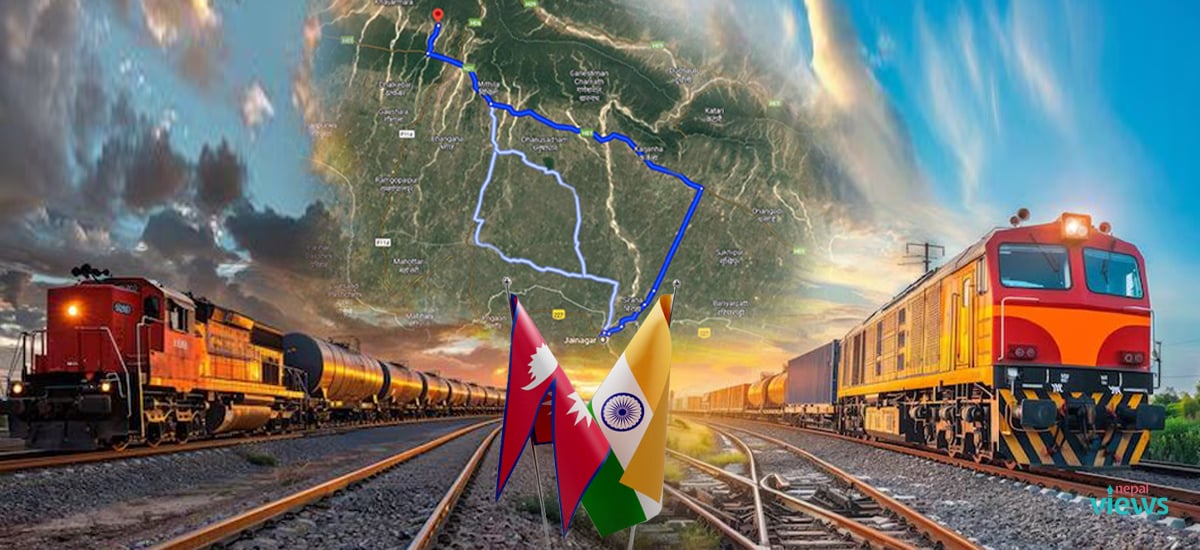

In recent years, India and Nepal have embarked on an ambitious journey to transform bilateral infrastructure ties via rail, marking a watershed moment in regional connectivity.
From the inauguration of the first broad-gauge rail link to the initiation of surveys for new corridors, the momentum underscores the strategic significance of rail-based integration.
The flagship Jaynagar–Bardibas project has emerged as the cornerstone of this connectivity push.
Phase 1, covering the Jaynagar (India)–Kurtha (Nepal) stretch (≈34 km), was inaugurated in April 2022 and began regular passenger operations on April 3, 2022.
Built under Indian grant assistance and managed by IRCON (Indian Railway Construction International Limited), two DEMU trainsets (5‑car, 1600 HP, AC + non‑AC coaches) were supplied by Konkan Railway to Nepal Railway Company, with Indian experts providing operational and maintenance support for the initial period.
Phase 2 (Kurtha–Bijalpura, ~17 km) was ramped up by mid‑2023 and formally inaugurated in July 2023. The final stretch (Bijalpura–Bardibas, ~17 km) is pending land acquisition by Nepali authorities, with construction expected to begin once clearance issues are resolved.
During the India‑Nepal PSC and JWG meetings in February 2025, Nepal reaffirmed its commitment to expediting approvals and facilitating these remaining sections.
The much-anticipated Raxaul–Kathmandu rail link — a 130‑136 km electrified broad‑gauge corridor — is currently in the DPR (Detailed Project Report) and feasibility stages.
Kathmandu–Delhi–Lucknow Triangle: New Dimensions of an Ancient Relationship
The route will traverse major towns like Jitpur, Nijgadh, Shikharpur, Sisneri, and Chobhar, featuring around 35 tunnels and 40 bridges. Preliminary engineering and traffic surveys have confirmed its viability, though Nepal has raised concerns over the long payback period (~25 years) and requested India’s technical input on financial structuring and capital viability.
Other proposed lines include Jogbani–Biratnagar (the first 8 km — Jogbani to Nepal Custom Yard — is already operational), the remaining ~10.6 km awaits approval; and Jalpaiguri–Kakarbhitta rail connectivity. These are in early stages.
As part of a broader scheme to bypass India’s Siliguri “Chicken Neck” and link Nepal’s Tarai belt, 14 new railway corridors totaling over 200 km in Nepal have received approval for final location surveys by the Indian Railway Board, highlighting a regional strategy to enhance trade and logistics across borders.
In Sikkim, Indian Railways has cleared the route survey for a Melli–Dentam line (≈75 km), potentially linking near the Nepal border (Chiwabhanjyang/Dentam) with the Sevoke–Rangpo network.
The survey, estimated to cost ₹2.25 crore (NRS 3.6 crore), aims to be operational by 2027, further expanding the regional rail grid.
Improvements in rail infrastructure are expected to deliver multiple benefits: Trade and commerce: Reduced logistics costs and faster freight movement, which can significantly boost Nepal’s export/import flows. Tourism and people‑to‑people ties: Enhanced access to cultural and pilgrimage centers such as Janakpur and Kathmandu. Geopolitical integration: The rail projects resonate with India’s Neighborhood First policy, reinforcing its role as Nepal’s key partner in regional development.
Both governments are also investing heavily in capacity building, with standard operating procedures developed by Indian Railways, staff training, and knowledge transfer through Konkan Railway and NRCL partnerships.
Despite the progress, certain obstacles could delay timelines.
A major hurdle is delays in land acquisition. Financial viability is another constraint, as Nepal’s apprehension about the Raxaul–Kathmandu payback period remains.
Both countries — especially Nepal — need to work on operational handover issues, ensuring long-term operation and management capacity within Nepal’s rail system post-Indian support.
With the full operational and upstream phases nearing fruition of the Jaynagar–Kurtha section, India–Nepal railway connectivity is on an irreversible upward trajectory.
The success of ongoing projects and the realization of mega‑corridors like Raxaul–Kathmandu could redefine how Nepal links with global markets — by rail rather than relying solely on road transport via India.
As both neighbors continue to coordinate through high-level Joint Working Groups and steering committees, the transformation from distance to direct rail access is within tangible reach.
India–Nepal rail connectivity is evolving from vision to reality, powered by grant‑funded infrastructure, strategic execution, and early operational success.
With key sections already in service and ambitious corridors in the pipeline, railway links are set to strengthen diplomatic ties, economic growth, and regional integration across the Himalaya.
(Yadav is a student of journalism at Dr B.R. Ambedkar Open University, Hyderabad)