


Nepal ‘Swarn Bhasma’ immunity campaign for children draws pediatricians’ ire
Last week, Health Minister Poudel rolled out a programme administering gold and honey mix to children — a move doctors call scientifically unproven.


Kathmandu: During the Covid-19 pandemic, Prime Minister KP Sharma Oli suggested unconventional ways to fight the virus — recommending gargling with turmeric, ginger, and guava leaves.
While scientists worldwide raced to develop a cure, Oli continued to claim that “Nepalis have strong immunity power.”
Now, Oli is prime minister again, and in his Cabinet, Nepali Congress’s Pradip Paudel serves as health minister.
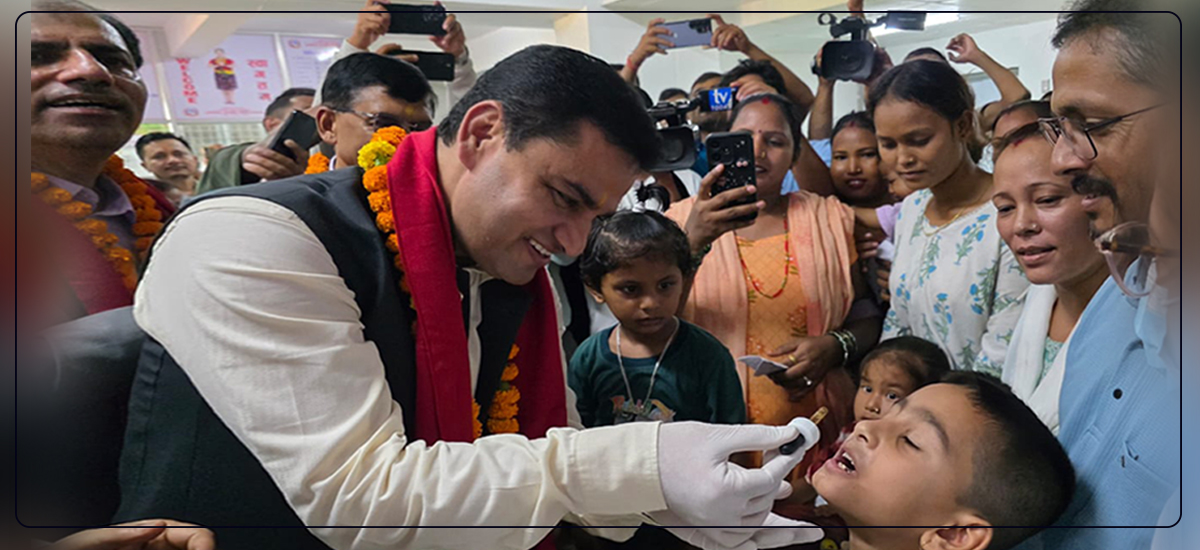
On August 21, Minister Paudel launched a government programme called “Rashtriya Swarn Bindu Prashan,” administering doses of “Swarn Bhasma” (gold ash) to children.
But Paudel’s move has sparked sharp criticism from medical professionals, who warn these so-called remedies are unproven.
The Nepal Pediatric Society has openly questioned the medicinal claims of the government’s “Swarn Bhasma,” emphasizing a lack of scientific evidence.
“There is no scientific study that shows ‘Swarn Bhasma’ boosts immunity,” said Dr. Ramhari Chapagain, the Society’s vice president and spokesperson, in an interview with NepalViews.
The Society has urged the government to halt distribution of ‘Swarn Bhasma’ to children immediately.
According to the Department of Ayurveda and Alternative Medicine, the “Rashtriya Swarn Bindu Prashan” programme targets children aged six months to under three years, with the government asserting the doses enhance immunity.
Dr. Shyambabu Yadav, Director General of the Department, confirmed the programme is active in 25 districts nationwide, with Minister Paudel officiating its launch.
“Swarn Bhasma is a mixture of ghee, honey, and gold ash,” Dr. Yadav explained. “We administer it to boost children’s immunity based on Ayurveda’s traditional science.”
However, Dr. Yadav did not clarify how exactly ‘Swarn Bhasma’ improves immunity.
“We introduced Swarn Prashan to build a disease-free Nepal,” he said, citing Ayurvedic scriptures that, he claims, confirm the preparation’s immune-boosting properties.
The government also asserts the programme supports children’s physical and mental development, including memory improvement.
But the Nepal Pediatric Society’s research warns against such claims.
Children under one year, they note, should never be given honey due to the risk of infant botulism, a serious illness.
Their studies also link gold-based medicines to allergic reactions, blood disorders, kidney and liver damage, respiratory problems, and diarrhea.
Alarmingly, the Society has detected toxic metals like lead, mercury, and arsenic in some Ayurvedic products, raising serious questions about ‘Swarn Bhasma’s’ safety, production standards, and dosage guidelines.
“There is no scientific proof that gold-containing materials enhance disease resistance,” Dr. Chapagain emphasised.
“The effects of gold compounds vary; in some cases, they may even suppress immunity. No credible study shows they reliably strengthen immunity in healthy children.”
Because of these concerns, the Nepal Pediatric Society demands an immediate stop to the use of ‘Swarn Bhasma’ and calls on the government to cease its distribution.
Medicinal products, they say, must clearly disclose ingredient quantities — especially when administered to vulnerable age groups.
“The dosage and composition must be age-appropriate. We have no data on the exact components or doses in Swarn Bhasma, nor proof of its effectiveness,” Dr. Chapagain added.
Meanwhile, the Department of Drug Administration has deferred responsibility for ‘Swarn Bhasma’ to Ayurvedic authorities.
Dr. Rupendra Puri, head of the department’s Ayurveda medicine branch, defended the practice, stating, “Swarn Bhasma is mentioned in Ayurvedic scriptures. It is traditionally mixed with ghee and honey for children’s growth.”
Describing it as a classical ritual, Dr. Puri said, “Just as children start solid foods at six months, there is a ritual called Swarn Prashan where Swarn Bhasma is given. This is that ritual.”
He also claimed the ‘Swarn Bhasma’ administered to children is officially registered and poses no side effects.
But medical studies paint a different picture.
A study published by the National Library of Medicine recounts a 35-year-old Kathmandu woman who developed jaundice, dizziness, and mild fever after taking ‘Swarn Bhasma’ from an Ayurvedic practitioner.
Instead of recovering, her condition deteriorated, forcing emergency admission to Patan Hospital in April 2018. The study points to kidney damage caused by toxic elements in the gold ash.
The research highlights the dangers of Ayurvedic medicines lacking clear ingredient labels — risking harm rather than healing.
“Every Ayurvedic product must transparently disclose the quantity of toxic elements,” the study warns, noting that microscopic gold particles entering the bloodstream pose significant health risks.
Adding to concerns, the government schedules the administration of this controversial medicine according to auspicious days and constellations.
Dr. Yadav explained, “We began giving this medicine on Pushya Nakshatra, an auspicious day according to Ayurvedic texts, believed to maximize effectiveness when administered in the morning. That’s why we started the programme from Dhangadhi on that day.”
On Sunday, the Nepal Pediatric Society issued a press statement voicing opposition to the government’s ‘Swarn Bhasma’ campaign.
In their statement on August 24, the Society stressed that current scientific evidence, child safety protocols, quality assurance, risk assessments, and regulatory clarity are all insufficient, underscoring a lack of basis for claims that Swarn Kalpa (gold preparations) enhance infants’ immune systems.