GSI and the game of silence: Nepal caught in the middle
Observers say China’s unilateral claim risks trust, while Kathmandu’s lack of response may imply tacit approval

Dipesh Shahi
09/01/2025 01:06 AM EDT7 min read
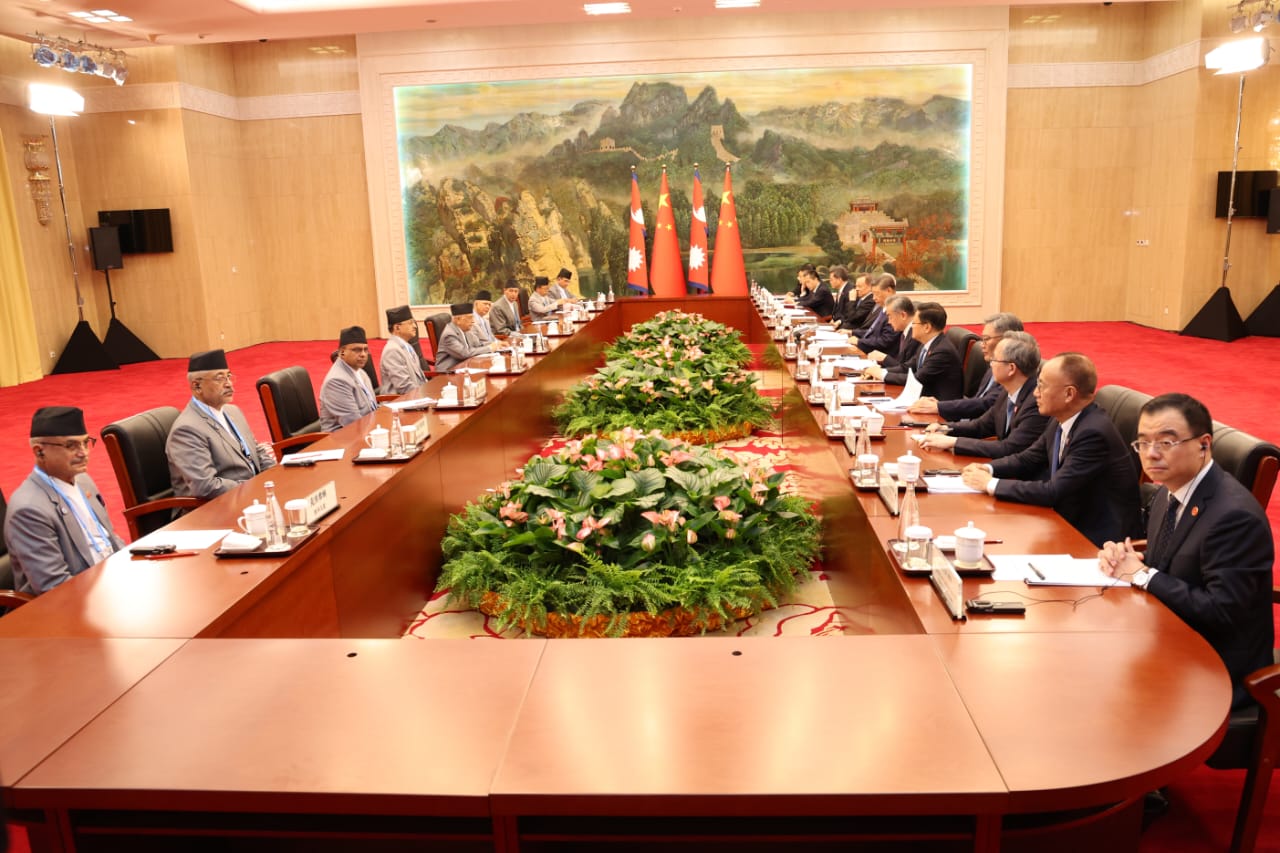
_ovwrw4nbzk_ZAV8sXtEFn.jpg) Prime Minister KP Sharma Oli meets Chinese President Xi Jinping in Tianjin in China on Saturday. Photo: Prime Minister’s Secretariat
Prime Minister KP Sharma Oli meets Chinese President Xi Jinping in Tianjin in China on Saturday. Photo: Prime Minister’s Secretariat
Kathmandu – The Chinese Ministry of Foreign Affairs issued a statement on Saturday claiming that Prime Minister KP Sharma Oli expressed support for China’s Global Security Initiative (GSI) during his meeting with Chinese President Xi Jinping.
The bilateral meeting took place in Tianjin, China, on the sidelines of the 25th Shanghai Cooperation Organisation (SCO) Summit and the “SCO Plus” gathering.
It was a unilateral claim by China that Nepal supported the GSI, an initiative it has long promoted.
The GSI, a security framework proposed by Chinese President Xi Jinping in April 2022, aims to promote a new model of international security that, according to Beijing, is based on mutual respect, cooperation, and non-confrontation.
Critics, however, argue that it serves China’s strategic interests by encouraging countries to align with its security vision.
The Embassy of Nepal in Beijing, which also issued a statement about the meeting between Prime Minister Oli and President Xi, made no mention of any support for the GSI. Similarly, China’s Foreign Ministry made no comment about the Lipulekh issue, which was clearly stated in the Nepali embassy’s release.
The statement from China’s Ministry of Foreign Affairs says: “Nepal has expressed support for the Global Development Initiative (GDI), the Global Security Initiative (GSI), and the Global Civilization Initiative (GCI) proposed by China.”
Among these initiatives, some GDI programmes have already been implemented in Nepal. But Nepal has consistently rejected the GSI, saying it contradicts the country’s non-aligned foreign policy. Nepal maintains that the GSI is a strategic, security-oriented initiative, and that it cannot join such strategic blocs amid rising global multipolarity.
The GSI is closely linked to Chinese President Xi’s security vision. GCI, however, has not drawn much attention in Nepal. Given this, China’s unilateral announcement that “Nepal has supported GSI” has raised serious concerns.
China’s old habits of unilateral claims
Indra Adhikari, an expert on foreign affairs, says China’s claim cannot be trusted unless it is verified by Nepal’s Ministry of Foreign Affairs or by PM Oli himself.
“We believe in what our government says. China’s statement doesn’t match the release from our embassy. None of the delegation members have commented on it,” she told NepalViews. “Our Foreign Secretary publicly detailed what was discussed, and GSI wasn’t mentioned.”
According to her, the official communication from the Nepal government should be trusted.
“Just because China included something in its statement doesn’t make it true. China has made many such unilateral claims before. Pokhara International Airport is a prime example,” she said.
China has similarly made unilateral claims under the Belt and Road Initiative (BRI).
Chinese ambassadors in Kathmandu have publicly stated that many projects, including the Pokhara airport, were part of the BRI, despite Nepal never officially confirming it.
Former Chinese ambassador Hou Yanqi and the current ambassador Chen Song have both faced criticism for such claims. Because Chinese diplomats often claim agreements that were never actually made, Nepal often finds itself in a dilemma over whether to trust everything China says.
Hence, diplomats are demanding that the Nepal government clarify whether it actually supported the GSI or not.
Nepal’s position
Deep Kumar Upadhyay, a former Nepali ambassador to India, says Nepal must clarify what actually happened during the bilateral meeting between Oli and Xi.
“We trust our own PM, foreign ministry, and its officials. Until they make an official statement, people will interpret the situation in different ways. So Nepal must clearly say ‘yes’ or ‘no’,” he said.
He also pointed out that China tends to label every project in Nepal as part of the BRI, which has created distrust.
Unless both sides include a matter in their joint or public statements, such topics cannot be considered as having been agreed upon. However, sometimes, due to domestic or international sensitivities, not all topics are made public.
In such cases, the absence of objection or a silent nod is taken as implied consent.
Journalist and author Gopal Khanal argues that one party writing something doesn’t mean the other side agrees.
“Just because China said it doesn’t mean Nepal accepted it,” he said. “We must trust our own PM, foreign ministry, and ambassador.”
If China made a false claim, Nepal has the right to object, Khanal added. “But even without objection, it does not mean Nepal accepted it. Nepal has consistently said it won’t join any military or strategic alliance of big powers,” Khanal told NepalViews. “That position hasn’t changed.”
Is China forcing GSI on Nepal?
Ever since Chinese President Xi introduced the GSI in 2022, Beijing has consistently pressured Nepal to join the initiative.
Adhikari questions whether this repeated pressure and unilateral announcement indicates an attempt to force the initiative on Nepal. “At a time when Nepal is diplomatically weaker, China seems to be pushing its strategic interests forcefully. If Nepal had really supported it, it would’ve included that in its own statement,” Adhikari said. “Nepal didn’t appear prepared for such a move either. Even if China raised the issue, Nepal is unlikely to have agreed during that meeting.”
She offered the Lipulekh issue as an example. “If we accept China’s statement, then we must also accept Nepal’s embassy’s statement, and that would mean: PM Oli raised the issue of Lipulekh being used by China and India for trade. If China hasn’t responded, does that mean they accepted it? No,” she said. “So silence should not be mistaken for approval; it’s a sign of diplomatic immaturity.”
Past incidents that raise suspicion
This isn’t the first time suspicion has arisen over China trying to push the GSI onto Nepal. On 5 October 2022, then-President Bidya Devi Bhandari sent a video message to a GSI-related conference, prompting criticism at home.
Despite the Ministry of Foreign Affairs advising against it, Bhandari participated, allegedly under the influence of the Chinese embassy in Kathmandu, which had lobbied political leaders including PM Sher Bahadur Deuba.
There are multiple examples of China pushing the GSI during bilateral visits and meetings.
On 29 December 2022, Liu Jinsong, Director-General of the Asia Department of China’s Foreign Ministry, urged Nepal's then-ambassador Bishnu Pukar Shrestha to support the GSI. China even released a statement about the meeting, but Nepal’s embassy didn’t respond publicly. Shrestha admitted he was approached but refused, citing Nepal’s non-aligned foreign policy.
Six months later, on 12 June 2023, during a visit to China, Nepal’s then-National Assembly Chair Ganesh Timilsina was again approached with the proposal by Zhao Leji, chairman of the standing committee of China’s National People’s Congress. Several other senior Chinese officials, including Wang Yi and Liu Jianchao, have brought up the GSI in discussions with Nepali counterparts.
Despite this ongoing pressure, China’s recent statement still doesn’t say Nepal has “joined” the GSI — only that it has “supported” it, which experts say can still create future complications.
Binoj Basnyat, a former major general and strategic analyst, warns that even just saying “support” is a step toward eventual participation.
“Support leads to progression. Tomorrow, this could mean Nepal is one step closer to full participation. Nepal’s current non-aligned foreign policy has no clear direction for a world that may divide into two strategic blocs,” he said. “Supporting any bloc now is not in Nepal’s national interest.”
Dipesh Shahi
09/01/2025 01:06 AM EDT7 min read