


Found… and lost?
To flounder now would not just weaken the interim government’s own credibility; it would risk erasing the one gain the movement truly secured — the idea that citizens, especially young ones, can still shape their republic.

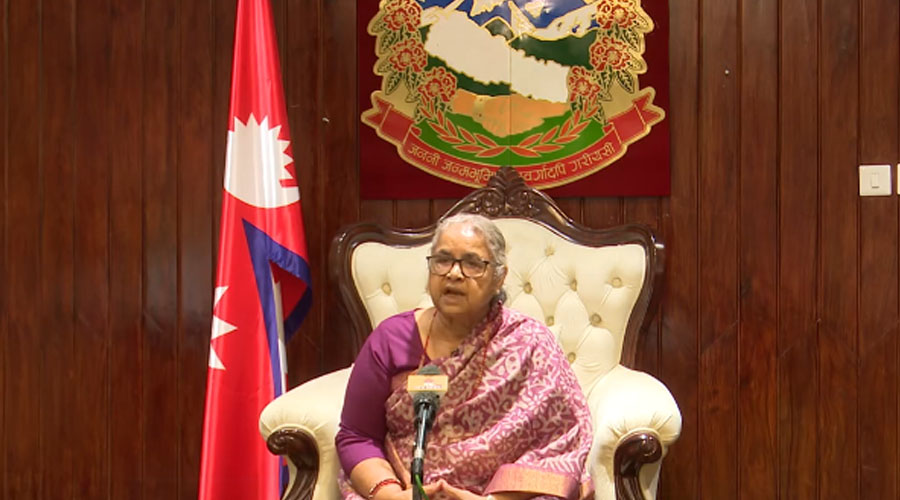

Had it not been for the youth-led movement, Nepal would not have found Sushila Karki as the head of the interim administration to fill the political vacuum created after the fall of an elected government.
After Gen Z campaigners chose Karki, President Ram Chandra Poudel “imposed” the duty on her.
Karki herself admitted as much during a recent interaction with journalists: “President Poudel told me that he would declare me unpatriotic if I refused to lead the government.”
So, in the wake of the September 8–9 youth-led protests, the Karki government was “found.”
In less than a week, it will complete two months in office. It has just four months left, with elections scheduled for March 5. Found in dramatic fashion, the government, however, already appears lost — in direction and in action.
Major political parties, mired in their own rivalries, have yet to fully commit to elections. The CPN-UML, whose chairman KP Sharma Oli was at the helm during the Gen Z protests, dismisses the Karki government as a dispensation “stitched up from the cacophony of the streets.” The Nepali Congress, Oli’s coalition partner during the same period, appears ambivalent and preoccupied with the timing of its general convention. The Maoist Centre — now leading a 10-front coalition under its old revolutionary name, the Nepali Communist Party — has declared its readiness to face voters but shows little clarity about what it stands for.
Govern, communicate, deliver: Nepal’s interim government has 149 days
All these parties feel sidelined. Convincing them to get to the hustings is a key challenge before the Karki government. Yet its bigger challenge comes not from the sidelined but from those who brought it to life — the Gen Z movement itself.
There is no single Gen Z bloc. Karki herself confessed recently, “I don’t know how many of them there are.”
The movement was launched to demand an end to systemic corruption and years of misrule, and to push for good governance. Over the weeks, new demands have emerged — some political, like a directly elected executive, and others radical, such as the arrest of Oli and Ramesh Lekhak, who was home minister in his cabinet.
Karki acknowledges that the demands are varied.
A crackdown on corruption would certainly win the hearts of ordinary Nepalis, but in a society where malpractice is so entrenched, it is easier said than done.
In its early days, the government thrived on symbolism: a clean slate, a former chief justice at the helm, technocrats with solid track records in her team, and a generation pacified by the promise of reform. But symbolism, like street slogans, fades quickly.
Two months in, the government seems to be losing its early clarity. Ministerial appointments were botched, raising questions about the vetting process. An ambassadorial recall decision landed in court, where judges ruled against the government’s plan. Industrialists are vexed by the decision to cut off electricity over unpaid dues.
The government knows that holding elections on the announced date is its main mandate, yet it is burdened by Gen Z pressure.
Caught between the push for reform and the need to lead the country to elections, the government found in a moment of urgency today feels lost in a labyrinth of expectations.
Karki, however, puts on a brave face.
“I have no plans to stay in office for even one extra day,” she said, reiterating her commitment to a democratic landing through elections on the announced date. Karki calls her government a mediator — between Gen Z campaigners and political parties, both of which are major stakeholders in the current transition.
And both appear to be on opposite sides of the spectrum. If the youth are restless, the old parties are resentful. One sees the interim government as the effector of everything; the other views it as one that has snatched their power.
The biggest political force, the Nepali Congress, reduced to watching from the sidelines, has its gaze fixed not on the national scheme of things but on its upcoming general convention. The UML, under Oli, mocks the Karki administration as a “street-born experiment,” an accidental outcome of chaos. The now-defunct Maoist Centre, though eager for elections, appears uncertain about what its renewed revolutionary banner truly means.
Together, they form a peculiar triangle of reluctance: unwilling to oppose a government that enjoys moral legitimacy, yet uneasy about supporting one that could make them politically irrelevant. Their discomfort can be a major source of the Karki government’s constraint — along with pro-monarchy forces that are in a perpetual quest to fish in troubled waters.
There is urgency among the youth, who demand immediate action, and failure to deliver invites threats. Sudan Gurung, who shot to fame with his self-proclamation as a key Gen Z leader, is turning into a gadfly. Karki did not deny Gurung’s role as a Gen Z representative; when asked about Gen Z campaigners, she offered a brief response: “There is Sudan.” Gurung has lately been making increasingly aggressive statements, his tone verging on threatening.
The wounded parties, on the other hand, are waiting for every opportune moment to pounce. It’s a delicate balance the Karki administration must maintain, or it risks losing its own sense of direction — torn between legitimacy and performance.
No matter how unexpectedly it was found, this government does not have the luxury to get lost. Karki does not hesitate to admit that.
The circumstances that gave birth to it were extraordinary — a youth-led awakening, a rare moment when street energy shattered the old order and forced the system to pause and listen. That momentum cannot be squandered in administrative confusion or political hesitation.
The Karki government may be interim, but its test is real. It must make the transition purposeful by instilling confidence that governance can mean more than optics and reaction. To flounder now would not just weaken its own credibility; it would risk erasing the one gain the movement truly secured — the idea that citizens, especially young ones, can still shape their republic.
For a government found in hope, to be lost in execution would be the most avoidable tragedy. Yet, with time still on its side and a purpose to rediscover, it can still find itself — before the country finds a new mandate, without getting lost in transition.