


Understanding Political Churn in Nepal


Kathmandu: Nepal’s politics at the moment does not feel dramatic. There is no obvious rupture, no formal breakdown of institutions, no single event that can be described as a turning point. And yet, there is a sense that something fundamental has shifted. Power continues to operate through familiar channels, but it does so without the confidence it once carried. Political authority still exists, but it no longer settles questions. It invites them.
The recent attention given to what is loosely called a Gen Z political awakening did not initiate this shift. It made visible what had already been taking place more quietly. For a long time, Nepal’s political system relied on repetition. Parties repeated their histories, leaders repeated their credentials, and voters repeated habits shaped by region, memory, and inheritance. That rhythm is now breaking down. Younger voters, in particular, appear less willing to extend trust simply because a party has governed before or claims a role in the past. This is apparent in how Nepal’s three main parties now behave and, just as importantly, in how they explain themselves.
The Nepali Congress still presents itself as the custodian of democratic legitimacy, especially in the Terai and the central hill districts where its organisational presence remains visible. But its public language has changed. Senior leaders now spend considerable time explaining why coalition politics is unavoidable, why instability is structural, and why compromise is responsible. These explanations are not inaccurate, but they reveal a party more concerned with managing constraints than articulating direction. At the level of local organisation, Congress workers increasingly acknowledge that younger voters are not mobilising with enthusiasm. The party is often neither opposed nor defended. It is simply treated as one option among many, without emotional attachment.
The CPN-UML projects greater confidence, though that confidence appears tightly controlled. In eastern hill regions where the party once encouraged internal debate and cadre participation, decision-making has become more centralised. Candidate selection and public messaging tend to follow directives from the top. Party leaders justify this as discipline and coherence. It has worked electorally in the short term. But it has also narrowed the party’s political language. UML still speaks of nationalism and development, but it rarely acknowledges uncertainty or dissent. This gives the impression of stability, but also of closure. For those outside its core support base, engagement feels limited.
The Maoist Centre faces a different problem. Its political authority was built on rupture and mobilisation, particularly in western Nepal. Today, its leadership continues to draw on that history, but often defensively. References to sacrifice and struggle do not always connect with voters who are more concerned with employment, migration, and service delivery. In many former Maoist strongholds, younger voters speak of the party as skilled in negotiation but unclear in purpose. Coalition politics has kept the Maoists relevant at the centre, but relevance does not automatically translate into credibility.
Across these parties, there is a shared pattern. They continue to govern, but they do not appear to persuade in the way they once did. Authority remains institutional, but its justification increasingly refers back to past contribution rather than present connection. That backward turn is significant. It is within this thinning space that figures such as Balen Shah and Rabi Lamichhane have gained attention. Their rise does not reflect the emergence of a new ideological bloc. It reflects dissatisfaction with the tone and habits of existing politics.
Balen Shah’s appeal in Kathmandu rests less on policy detail and more on posture. When questioned, he rarely engages in extended political explanation. He refers instead to rules, deadlines, and procedure. He acts first and justifies later, if at all. This approach has provoked criticism, but it has also generated support precisely because it contrasts with a political culture where delay is often framed as responsibility. His authority comes from execution rather than representation. That inversion unsettles parties whose legitimacy depends on mediation and negotiation.
Rabi Lamichhane’s style is different. His politics is built through exposure and confrontation. In public statements and interviews, he names institutions, points to specific failures, and personalises responsibility. Critics describe this as populist or reckless. Supporters see it as overdue. His appeal is strongest among voters who feel that politics has learned to hide behind process and language. He does not offer a fully formed programme, but he articulates anger without embarrassment. That alone has political value in the current climate.
Neither figure yet represents a stable alternative. Their influence is uneven and concentrated largely in urban and media-connected spaces. Still, they have changed the criteria by which leadership is judged. Voters increasingly evaluate leaders not by lineage or ideology, but by how they respond when challenged. Performance has begun to matter more than pedigree. Regionally, Nepal has not experienced a clear political realignment. The Terai continues to be shaped by questions of representation and inclusion. The hills remain influenced by historical narratives. What has changed is the emotional relationship to politics. Migration hangs over everyday conversations. Young people leave for work abroad not as an act of protest, but as a practical decision. Politics becomes background noise rather than a source of expectation. When governance does not appear to shape outcomes, loyalty weakens quietly.
Monarchist groups operate within this atmosphere without pressing themselves to the forefront. Their interventions are limited and symbolic. They speak of order and continuity and allow dissatisfaction with democratic politics to accumulate on its own. Their appeal grows less through active mobilisation and more through comparison. When democratic politics appears exhausted, symbolic authority begins to look less implausible.
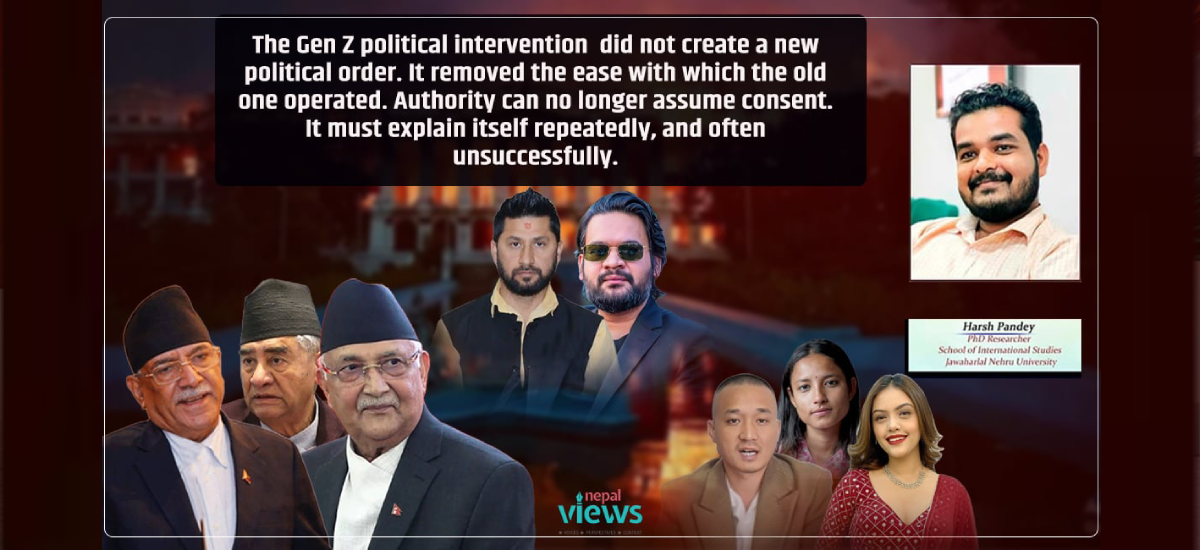
Nepal today is therefore governed, but not anchored. Established parties control institutions but struggle to command belief. New actors command attention but lack organisational depth. Monarchist voices persist at the margins, waiting rather than competing. None of these forces can fully displace the others. The Gen Z political intervention did not create a new political order. It removed the ease with which the old one operated. Authority can no longer assume consent. It must explain itself repeatedly, and often unsuccessfully. Whether this condition leads to renewal or prolonged drift will depend on whether political actors can learn to govern without relying on habit. For now, Nepal’s politics remains unsettled. Not broken, but exposed.
Harsh Pandey is a PhD Candidate at the School of International Studies, JNU, New Delhi. He is also a Life Member of the International Centre for Peace Studies, Delhi.