


11 possible PM candidates — with caveats and conditions

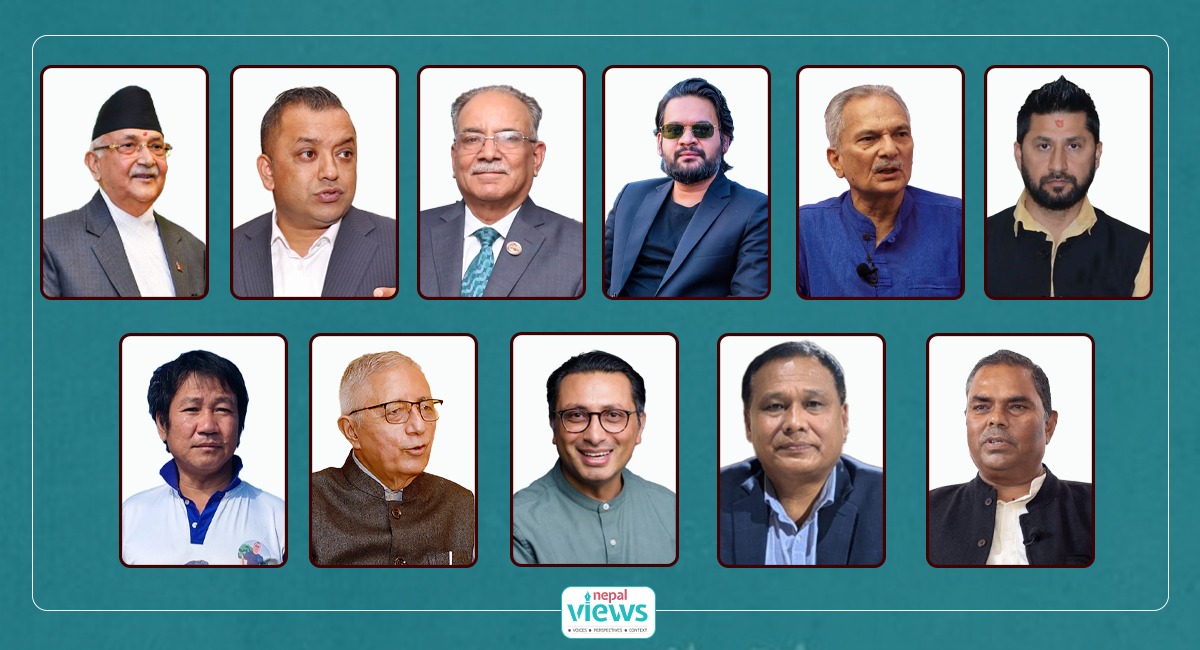

Kathmandu: With nominations closed on January 20, the stage has been set for the March 5 parliamentary elections. According to the Election Commission, 3,484 individuals have filed candidacies for 165 constituencies nationwide, with 2,297 running on party tickets and the rest contesting independently. Some may withdraw, and some could be barred from running. Under the proportional representation system, 110 members will be elected, for which 3,213 names have been submitted by 63 parties.
The structure of the next parliament will emerge from these candidates.
It is too early to predict election results. However, some names are seen as potential claimants for the prime ministerial post, based on their seniority within their parties. Two prime ministerial candidates — CPN-UML Chair KP Sharma Oli and Rastriya Swatantra Party (RSP) leader Balendra Shah — are running from Jhapa-5. Only one of them will remain in the list of potential PMs after the election.
Considering party leadership structures and claims, one of the following 11 individuals could become prime minister after March. Whether each will win their seat is still uncertain, but if elected, different conditions would apply for them to become PM.
1. KP Sharma Oli
The first likely candidate is UML Chair KP Sharma Oli. If he wins in Jhapa-5, no other UML candidate can block him from becoming parliamentary party leader. If Oli, 73, loses, UML could choose any leader. Currently, Oli, a three-time prime minister, is the central figure in UML.
Winning the election and becoming parliamentary party leader alone is not enough; UML must also achieve a majority or lead a coalition. The likelihood of UML gaining a majority is very low. In the last election, UML received around 27 percent of total votes and had fewer seats than the Nepali Congress, which emerged as the single largest party. The Gen Z protests, new parties, and the formation of the Nepali Communist Party add further challenges for UML.
However, if UML becomes the largest or second-largest party and can form a coalition, Oli is likely to stake claim to the PM post.
2. Pushpa Kamal Dahal
Dahal, the coordinator of the Nepali Communist Party and former prime minister, has not lost his chance of becoming PM. Seeking a strong constituency, he is contesting Rukum East, the base of the Maoist civil war, where his chances of winning are high.
Another former PM, Madhav Kumar Nepal, who is also part of the NCP, is contesting Rautahat-1. If he loses or even wins, he is unlikely to block Dahal from becoming parliamentary party leader, as Nepal may face suspension due to corruption cases involving Patanjali Yoga and Ayurveda company land disputes.
If Oli loses in Jhapa-5, non-communist and new parties perform strongly, and the leftist movement faces a crisis, a push for leftist unity could emerge, paving the way for Dahal to become PM. Likewise, if new parties force both UML and Congress out and a coalition government must be formed, Dahal’s chances increase.
3. Gagan Kumar Thapa
Nepali Congress President Gagan Kumar Thapa, elected through a special convention, is another strong contender. With Bishwo Prakash Sharma not contesting, future government and party leadership could be shared between Thapa and Sharma.
Thapa has shifted from Kathmandu-4 to Sarlahi-4 to regain support in Madhesh. He faces competition from Amresh Kumar Singh of Rastriya Swatantra Party, who had previously won this seat independently.
If Thapa wins, no one can block him from becoming the Congress parliamentary party leader. For him to become PM, Congress must achieve a majority or lead a coalition. In the last general election, Congress received around 25 percent of votes and became the largest party by seats. Its majority prospects remain uncertain, but if it emerges as the largest party, old parties may accept Thapa as PM.
4. Balendra Shah
RSP leader Balendra Shah, former Kathmandu mayor, is contesting parliamentary elections independently. His first challenge is winning Jhapa-5, where he lacks a local political base or strong connections. His main support comes from his mayoral publicity and RSP’s growing organisation.
If elected, he will become RSP’s parliamentary party leader, as the party has already projected him as PM candidate. However, achieving a majority or coalition leadership will be extremely difficult. Other parties, including Congress and UML, may not accept him as PM. Shah could become PM only if RSP becomes the largest party and gets support from others.
5. Kulman Ghising
Ujyalo Nepal Party Chair Kulman Ghising, famed for ending Nepal’s chronic power outages, claims his name alone could attract 1.4–1.5 million votes. He contests Kathmandu-3.
For Ghising to become PM, his party would need unexpectedly strong performance, potentially becoming a significant coalition partner. Otherwise, his chances remain slim.
6. Harka Sampang
Shram Sanskriti Party Chair Harka Sampang, known for his eccentricity, is contesting from Sunsari-1. He has claimed himself as a major PM contender and strongly opposes leaders like Rabi Lamichhane, Balendra Shah, and Kulman Ghising.
Sampang’s path to PM requires his party to deliver extraordinary results, which seems unlikely. If elected, he will become his party’s parliamentary party leader.
7. Upendra Yadav
Upendra Yadav does not personally claim to be PM. However, following the merger of Mahanta Thakur’s Democratic Socialist Party with Yadav’s Janata Samajwadi Party, it could become the largest Madhesh-centered party.
If major parties hesitate to nominate a PM from their ranks, Yadav could theoretically be accepted. He contests Saptari-3, having previously served as Deputy Prime Minister and won a by-election in 2023.
8. Dr. Baburam Bhattarai
Former Maoist leader Dr. Baburam Bhattarai, who now rejects communism, could become a compromise PM if no party achieves a clear majority and coalition formation is difficult.
He is contesting Gorkha-2 and will face strong competition.
9. Rabi Lamichhane
RSP Chair Rabi Lamichhane’s PM path requires three conditions:
1. Balendra Shah must lose in Jhapa-5.
2. Lamichhane must clear cooperative fraud and asset-cleansing cases.
3. His party must have the capacity to lead a majority or coalition.
All three occurring simultaneously is unlikely. He contests Chitwan-2.
10. Dr. Shekhar Koirala
If Gagan Thapa loses in Sarlahi-4 or if internal Congress dynamics require adjustment, Dr. Shekhar Koirala could become PM.
He contests Morang-6, his traditional seat.
11. Dr. Swarnim Wagle
Low-profile RSP leader Dr. Swarnim Wagle could emerge if:
1. Balendra Shah loses,
2. Rabi Lamichhane fails to clear his cases,
3. RSP still needs to lead the government.
He contests Tanahun-1.