Experts term Congress, UML’s bid to oust Deputy Speaker misuse of constitutional provisions
Ruling parties accused of parliamentary deviation and exploiting the constitution to secure a majority in the Constitutional Council.

Shisir Dhakal
08/20/2025 12:55 AM EDT8 min read
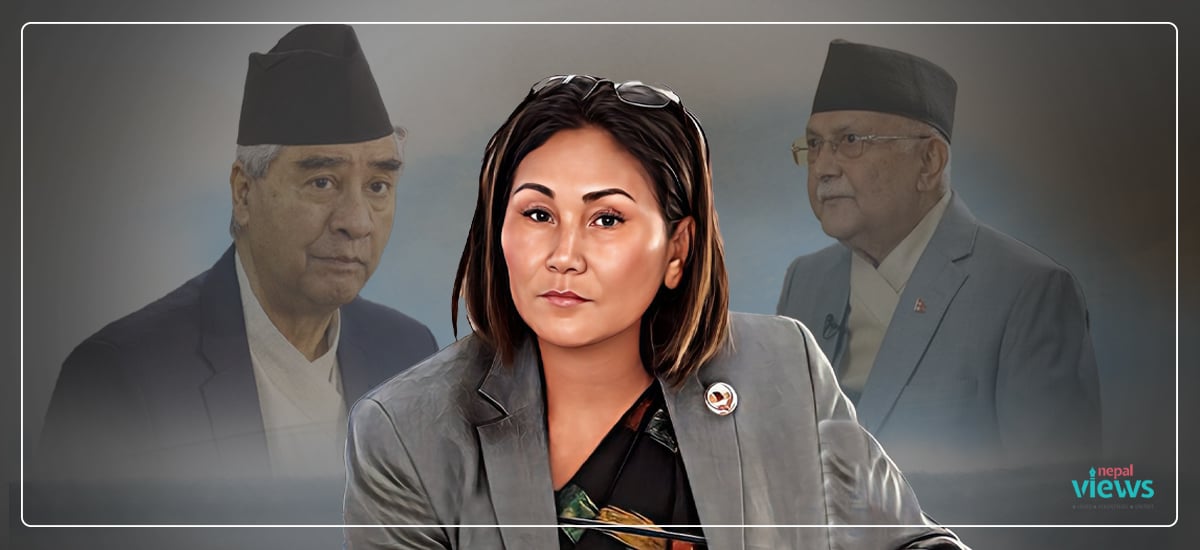

Kathmandu: The ruling Nepali Congress and CPN-UML on Tuesday collected signatures from their lawmakers with a view to registering a proposal in the House of Representatives to remove Deputy Speaker Indira Rana from her post on grounds of “misconduct incompatible with her office.”
With difficulty in securing a majority in the Constitutional Council, the ruling parties have resorted to reviving a case from 30 months ago to push for her removal under constitutional provisions.
Experts interpret the move by the Congress and UML as parliamentary deviation and a misuse of the constitution for political interests.
Deputy Speaker Rana is currently in the United States.
She is scheduled to return to Nepal on September 28, after which the ruling parties plan to file the proposal in the House of Representatives.
Congress lawmaker Pratima Gautam, who provided her signature to her party, said, “We have learned that the Congress and UML have agreed not to move the proposal forward while the Deputy Speaker is abroad.”
On February 27, 2023, Deputy Speaker Rana had corresponded with the U.S. Embassy in Kathmandu requesting to advance the date of visa interviews. Using the parliamentary letterhead, she requested the embassy to reschedule the visa interviews for herself and five others. However, the individuals she recommended were unrelated to parliament.
The letter became public in mid-July 2024 and sparked intense debate in parliament.
The Nepali Congress had even demanded Rana’s resignation, accusing her of misconduct unbecoming of her office.
Article 91 of the constitution and Rule 210 of the House of Representatives Regulation allow for the filing of a proposal against the Speaker or Deputy Speaker on grounds of “misconduct incompatible with their office.”
The ruling Congress and UML now seek to use this provision to file their proposal after September 28.
There are two key political motives behind the effort to remove Deputy Speaker Rana. First, to secure a majority in the Constitutional Council. Second, to ramp up pressure on the Rastriya Swatantra Party (RSP) to lift their parliamentary obstruction.

The six-member Constitutional Council currently finds the ruling coalition in the minority. It consists of the Prime Minister, Speaker, National Assembly Chairperson, Chief Justice, Deputy Speaker, and the Leader of the Opposition. At present, the ruling side has two members, and the opposition three. The Prime Minister and Speaker hail from UML, the National Assembly Chairperson from the Maoist Centre, and the Leader of the Opposition is Maoist Centre Chair Pushpa Kamal Dahal.
To facilitate smoother appointments to constitutional commissions, a bill was passed by both houses of the federal parliament to amend the Constitutional Council Act. However, the President returned the bill, stating it contravened the constitution. Following this, the ruling coalition moved forward with removing the Deputy Speaker elected from Rastriya Swatantra Party and appointing a Deputy Speaker from the Congress.
On September 19, at a Congress office bearers’ meeting, party President Sher Bahadur Deuba briefed that the government was facing difficulties with appointments to constitutional commissions due to lack of majority in the Constitutional Council.
“Without a majority in the Constitutional Council, the government is struggling with appointments to the constitutional commission. We have to find ways to secure a majority,” Deuba is learned to have said.
Before this meeting, on September 18, Deuba had discussions with Prime Minister KP Sharma Oli at Baluwatar.
A Congress official said that PM Oli, during the discussion, proposed that since the Rastriya Swatantra Party was obstructing parliament over demands to punish Home Minister Ramesh Lekhak in a human trafficking case, the action against the Deputy Speaker should proceed from within Rastriya Swatantra Party itself.
“Rastriya Swatantra Party has been obstructing parliament demanding action on the human trafficking case. Let’s fulfill their wish. Let the action proceed from within the party,” the Congress official told NepalViews.
After PM Oli proposed the removal of Deputy Speaker Rana, Congress President Deuba agreed, and signature collection began, said Congress Chief Whip Shyam Ghimire.
“The signatures were collected following an agreement between Congress and UML leadership. Since some lawmakers are abroad, all signatures have not yet been gathered,” he said.
A complaint was filed in the State Affairs and Good Governance Committee of parliament on July 17, 2024, regarding Deputy Speaker Rana’s letter to the U.S. Embassy. At that time, action could have been initiated against her. However, experts now consider the current attempt to remove her a misuse of constitutional provisions. They point out a clear constitutional and parliamentary deviation by the Congress and UML.
Constitutional law expert Bhimarjun Acharya criticized the ruling coalition for attempting to seize full control of the state by misusing the constitution.
“If the Congress and UML were honest with the constitution, they would have acted as soon as the case became public. Moving this proposal now for political gain is constitutional misuse,” he said.
The ruling coalition’s misuse of the constitution to facilitate easy appointments to constitutional commissions is also seen as highly objectionable.
Constitutional law expert Bipin Adhikari said, “Congress and UML have proceeded with ill intent for party gain. This step misusing constitutional and parliamentary powers is very objectionable.”
There is no statute of limitation for disciplinary action against constitutional officeholders for misconduct. This means officials can be held accountable any time, but experts argue that selective silence in favorable cases and harsh action in adverse ones is inappropriate.
Provisions for disciplining constitutional officers ensure their accountability to their official duties. Given the dignity and independence of these officers, disciplinary processes are made complex. However, in Nepal, even this complex procedure is often exploited for political interests. There have been instances where political retaliation or interests have not justified actions against constitutional officers.
Political parties have introduced such proposals in parliament before. Since the new constitution’s enactment in 2015, two such proposals have been filed.
On April 30, 2017, an impeachment motion was filed against then Chief Justice Sushila Karki by the then ruling Congress and Maoist Centre. The motion was later withdrawn.
On February 12, 2022, an impeachment motion was filed against then Chief Justice Cholendra Shamsher Rana by the then ruling Congress and Maoist Centre. But the motion never got logically concluded, as Cholendra retired due to age bar.
Using disciplinary actions against constitutional post holders as weapons can lead to lawlessness and authoritarianism. Despite criticism, such moves have not ceased.
Parliamentary affairs expert Rajendra Phuyal argues that Congress and UML’s move against the Deputy Speaker due to political opposition is wrong.
“If anyone abuses their office, they can be held accountable at any time. But remaining silent when favorable and initiating action when adverse is wrong,” he said.
Following news of Congress and UML collecting signatures to remove the Deputy Speaker, criticism of the ruling coalition has intensified.
Opposition parties have warned that they will strongly oppose this step, concluding that the government is moving towards authoritarianism.
Meanwhile, lawmakers from Congress and UML themselves have not received “official information” on the purpose of the signature collection.
UML lawmaker Gokul Baskota, who provided his signature, said, “We were told to sign and we did. But I don’t know for what purpose or how the signatures will be used.”
Constitutional law expert Adhikari criticized Congress and UML for misleading even their lawmakers.
“Collecting signatures from lawmakers without any explanation to prepare a background for removing the Deputy Speaker is against parliamentary decorum,” he said.
While UML is unanimous in collecting signatures, controversy exists within Congress. Some leaders from the dissenting faction, including Shekhar Koirala, have refused to sign.
“There was no discussion with us about the signatures. No one informed us why signatures were being requested,” Koirala told NepalViews.
Parliamentary affairs expert Phuyal also criticized Congress and UML for this act.
“At least the party should inform lawmakers why signatures are being collected. Without disclosing the purpose, it’s unreasonable to expect transparency from such parties,” he said.
_6e5Wir38CR.jpg)
How does the process proceed in Parliament?
According to Rule 210 of the House of Representatives Rules, a proposal can be registered if the Speaker or Deputy Speaker is found not acting in accordance with their official duties. The proposal must be submitted with the support of at least one-fourth of the current members of the House to the Secretary-General of Parliament.
This is why the ruling parties have collected signatures. If the letter with signatures is submitted to the Secretary-General, he must forward the proposal to the Speaker as per Rule 210, Sub-rule 2.
Within seven days of registration, the proposal must be scheduled for discussion in the House. The accused official can participate in the discussion and voting.
If two-thirds of the members support the proposal, the Deputy Speaker is removed. This requires 183 lawmakers.
To secure the two-thirds majority, the ruling Congress and UML have held talks with the Janata Samajwadi Party Nepal and the Nagarik Unmukti Party. Currently, Congress and UML hold 88 and 79 seats respectively, while Janata Samajwadi Party has 7 and the Loktantrik Samajwadi Party 4 seats. This gives the ruling coalition 178 members. The Janamat Party with 6 seats and Nagarik Unmukti Party with 4 seats have also pledged support, ensuring the two-thirds majority will be met.
This story was originally published in Nepali.
The Nepali version of the story
Shisir Dhakal
08/20/2025 12:55 AM EDT8 min read
_LqGDyrjJvx.jpg)