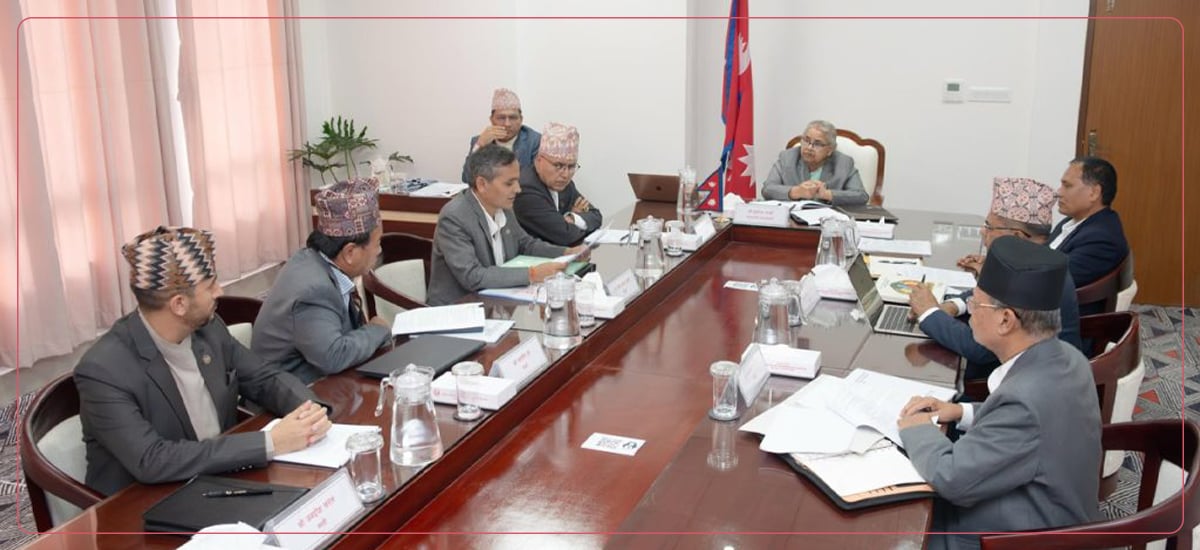
How Karki’s interim government faced embarrassment over vetting lapses
Controversial nominations and weak background checks of would-be ministers raise questions about the interim administration’s decision-making process

Shisir Dhakal
10/28/2025 12:58 AM EDT8 min read
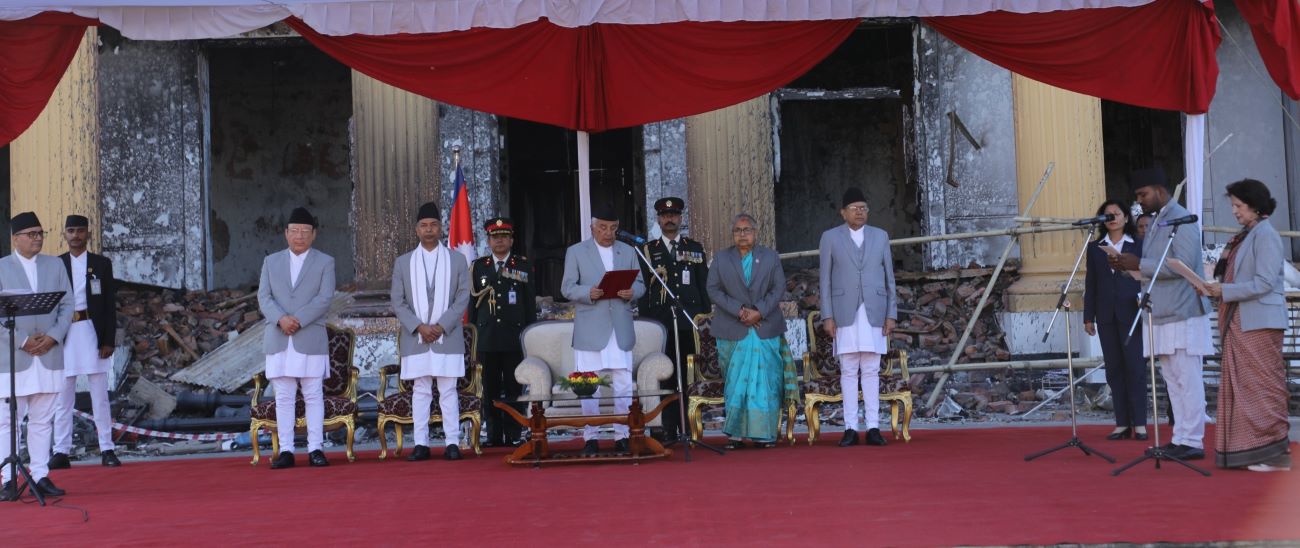 President Ram Chandra Poudel administers the oath of office and secrecy to newly appointed Health Minister Sudha Gautam and Youth and Sports Minister Bablu Gupta at the Office of the President on Sunday.
Kathmandu: On September 21, a letter recommending Dr Sangeeta Mishra as Health Minister reached the Office of the President, Sheetal Niwas. Soon after, reports surfaced that Dr Mishra was facing a case at the Commission for the Investigation of Abuse of Authority (CIAA) over alleged irregularities in the procurement of medical equipment.
After news about her case was widely reported in the media, insinuating that the anti-graft agency had “communicated” to Karki that it was set to file a case against her at the Special Court, her name was removed from the list of ministers the very next day, September 22.
The government drew flak from various quarters, with questions even being raised about how an independent constitutional body was “in communication” with the executive over the cases it was pursuing. Filing a graft case at the CIAA is not unusual in Nepal, and unless the case is formally registered in court, the person in question is, in principle, not disqualified from assuming office. But Karki retreated from her decision amid highly charged media reports.
A little over a month later, on October 25, interim government head Sushila Karki was preparing to appoint Khagendra Sunar as Minister for Labour and Employment. Once again, media reports revealed that there were criminal complaints against him at the police and contempt of court cases. Karki withdrew the decision to appoint him.
The incidents have raised questions about the ministerial selection process under the interim government: Who recommends the names of ministers? Who conducts background checks? And how are they approved?
After being appointed head of the interim government, Karki told the BBC Nepali Service that the selection of Cabinet members would be done in consultation with “friends and well-wishers.”
“There are many lists. I consult friends. The nominees must have willingness, expertise, independence and integrity. Inclusiveness will be the main consideration in cabinet expansion,” she told the BBC.
However, Karki did not reveal who these “friends” were. Among those in dialogue with Karki are several Gen Z representatives. Bhavana Raut is one of them.
In an interview with NepalViews, Raut clarified that Gen Z representatives did not interfere in Cabinet appointments.
“We have no role in expanding the Cabinet. It’s entirely the Prime Minister’s prerogative, and we cannot intervene,” she said.
She added, however, that they had urged the Prime Minister’s Secretariat not to proceed with the appointments of controversial figures.
“When news broke about Khagendra Sunar’s controversial background and multiple cases, we contacted the Secretariat to stop the appointment,” she told NepalViews.
Before his nomination, activist Sunar’s controversial past had been largely ignored. Only after the media reports — and intervention from Gen Z representatives — was his appointment halted.
Experts say verifying a minister’s background is not difficult, as it can be done through the police, intelligence agencies and the CIAA. Neglecting such vetting, they say, has caused embarrassment for the government.
Observers Kedar Bhakta Mathema and Vidyadhar Mallik said the government suffered reputational damage due to weak background checks.
“The Prime Minister can easily ensure that an appointee has a clean record. We have police, intelligence and oversight bodies for that. But failing to vet candidates for high office leads to embarrassment,” said Mathema.
Both Mathema and Mallik were invited as observers at the October 20 dialogue between political parties and the government.
Mallik, a former minister, believes that Karki may have failed to conduct thorough background checks due to pressure from multiple groups. He recalled that in 2013, under then Chief Justice Khil Raj Regmi, an interim government was formed with cross-party agreement that only former secretaries would be appointed as ministers. Mallik, who served in that government, said the current situation is different.
“Now, instead of consensus-based nominations, various groups are recommending their own candidates, creating pressure on Karki,” he said. “There are divided and competing Gen Z groups. If appointments were based on all-party consensus, it would be easier for the Prime Minister. But now, with a fractured movement, she faces pressure about whom to listen to. Despite her bold nature, background vetting must be mandatory before any appointment.”
The Karki government was formed on September 12 in the wake of the September 8–9 Gen Z protests against corruption and misrule. What started as peaceful protests on September 8, sparked by a social media ban, spiralled out of control on the second day, resulting in vandalism and the torching of not only state infrastructure but business enterprises as well.
Kulman Ghising, a former Nepal Electricity Authority (NEA) chief, was appointed Energy Minister. His decision to transfer Hitendra Shakya, who had replaced him at the NEA, invited criticism, as it was seen as an act of vengeance. At Ghising’s order, electricity supply to some industries that he believes have not cleared their dues has been cut. While Ghising is highly regarded by many as the man who ended the years-long load-shedding in the country, his move to stop power supply to industries has left the business community in shock.
During a meeting with industrialists on September 21, Karki reportedly said that Cabinet formation would have been difficult if she had not included Ghising — showing the influence he holds.
“Had we not included Mr Kulman, the Cabinet would not have been formed,” she said.
On September 11, a group called Gen Z Nepal publicly released a statement supporting Ghising’s inclusion in the Cabinet. It is unclear, however, whether this was the same group that pressed for his appointment.
Karki’s interim government was formed to oversee the upcoming elections. Finance Minister Rameshwor Khanal had pledged that the election government would not influence the bureaucracy.
Karki’s Cabinet: Inclusivity praised, selection process questioned
Karki’s Cabinet includes Rameshwor Khanal, Anil Sinha, Om Prakash Aryal, Ghising, Jagdish Kharel, Mahabir Pun and Madan Pariyar, appointed in the first and second phases. The nomination of Dr Mishra caused controversy during the second expansion, and Sunar’s nomination did the same in the third.
Although four new ministers were expected to take the oath on Sunday, only two — Sudha Gautam and Bablu Gupta — were sworn in.
Karki has committed not to expand the Cabinet beyond 11 members. She had earlier promised that her government would be inclusive, saying,
“The Cabinet will ensure inclusion — representing indigenous groups, Dalits, women and marginalised regions,” she had said.
While Karki has been praised for promoting inclusivity, her selection process and ministerial reshuffles have faced scrutiny.
Congress leader Govinda Raj Pokharel lauded Karki for implementing meritocracy and inclusion in practice, writing on X (Twitter): “Congratulations and best wishes to PM Sushila Karki. She has truly demonstrated meritocracy and inclusion in action. A good selection indeed.”
In her interview with BBC Nepali, Karki had said that the appointees’ expertise and willingness would also be considered.
Heritage activist Ganapati Lal Shrestha said he was qualified to lead the Ministry of Culture and Tourism based on his professional background. Although the Prime Minister initially agreed on October 24, the following day his portfolio was changed to the Ministry of Land Management, Cooperatives and Poverty Alleviation, prompting him to decline the appointment.
Shrestha said that when he tried to discuss the matter, the Prime Minister advised him to talk to Home Minister Om Prakash Aryal instead. Aryal reportedly told him that “a powerful force” had worked against his appointment to the Tourism Ministry.
“When I asked about the promise made last night, she said nothing and looked away,” Shrestha said in a statement. “Since this government is meant to be based on expertise, I didn’t want to become a minister just for the title.”
Civil society leader Mathema said Shrestha should have been given the Tourism Ministry in accordance with his expertise.
“He has worked in heritage conservation and could contribute well to culture and tourism. The portfolio should match the person’s expertise,” Mathema said.
CPN-UML General Secretary Shankar Pokharel also questioned the selection process, pointing out that some nominees recommended as movement representatives were later withdrawn.
“When the names of movement representatives are retracted right after being made public, what does that indicate, Prime Minister?” he asked.
Chief Adviser Ajaya Bhadra Khanal admitted that the disagreement over Shrestha’s portfolio was the reason for his withdrawal.
“He was assigned the Land Management Ministry on Sunday morning, but there was disagreement over the portfolio,” Khanal said.
Karki’s interim government has now completed one and a half months since its formation. Despite being mandated to conduct elections by 5 March, the Cabinet has faced hurdles in taking full shape. Karki herself appeared frustrated when asked by reporters on October 16 about the delay.
“It’s being done, it’s being done continuously,” she responded curtly.
As per her commitment, one ministerial seat still remains to be filled. The recurring controversies over transparency and background checks suggest deeper flaws in the decision-making process.
Chief Adviser Khanal acknowledged that some controversial names were recommended due to weak background verification mechanisms.
“In the coming days, the government will strengthen its vetting system and prioritise the appointment of individuals with a clean image,” Khanal told NepalViews.
This article is a translation of a piece originally published in Nepali. Read the original version here
Shisir Dhakal
10/28/2025 12:58 AM EDT8 min read