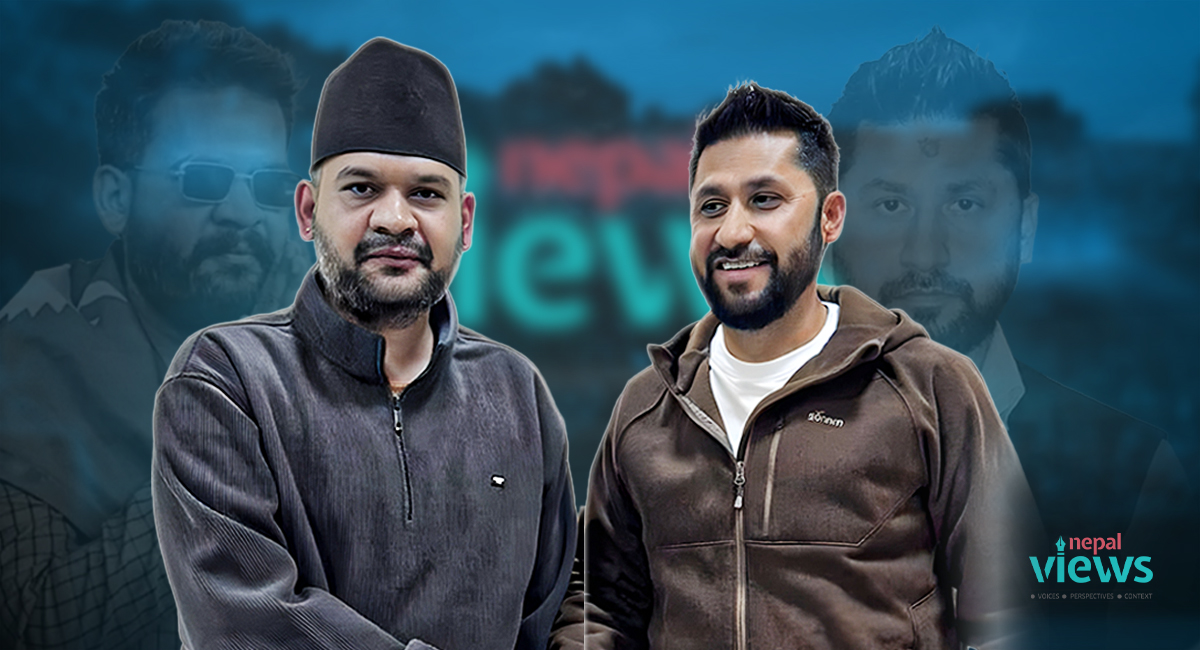
When chalk meets cheese
Balendra Shah and Rabi Lamichhane make strange bedfellows; will the contrasts clash or dovetail in shaping Nepal’s political future?

NRNHub
01/01/2026 07:56 AM EST5 min read
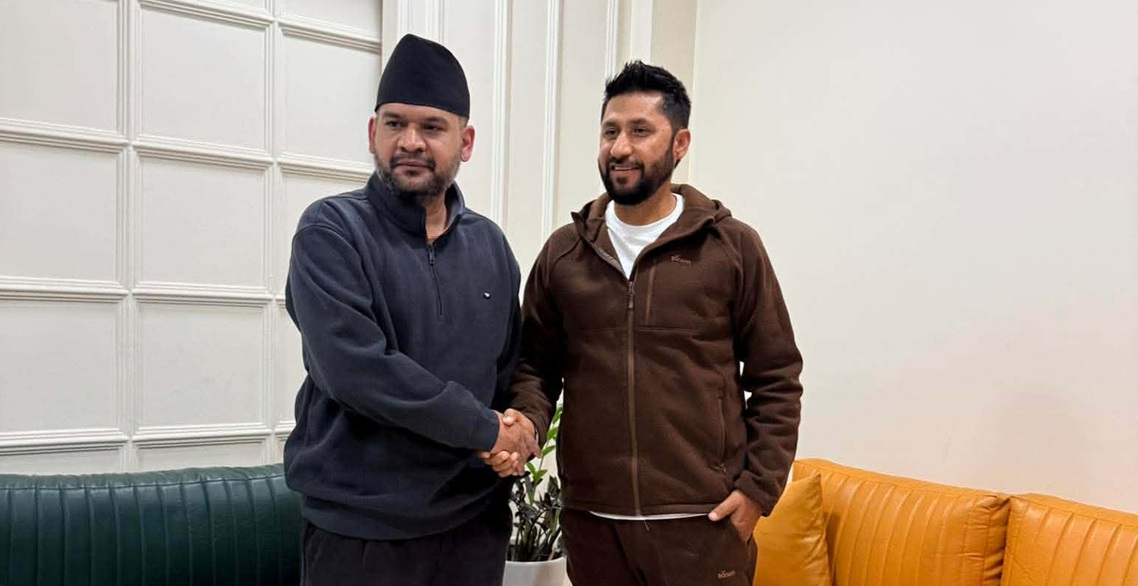

One is off-standish. The other, garrulous. One is a silent operator; the other thrives on noise.
They are chalk-and-cheese personalities.
Thus goes an old adage: politics makes strange bedfellows, and Kathmandu Mayor Balendra Shah and Rastriya Swatantra Party chair Rabi Lamichhane have just proved it by forming an unexpected alliance.
The media frenzy over the deal between them — that Shah would be the RSP’s prime ministerial candidate with Lamichhane leading the party — was spectacular.
The durability of this partnership, however, remains questionable. The coming together of the two — one 35 years old, the other 51 — is a result of the political churn Nepal has witnessed in recent months after the Gen Z protests. This alliance is clearly a product of timing.
The September Gen Z protests, which exposed deep public frustration with corruption, misgovernance, and the recycling of political elites, put the old guard on the defensive. Though the Nepali Congress, UML, and the Maoists (now the biggest stakeholder in a bloc of left-leaning parties named the Nepali Communist Party) are reorganising after being forced to lick their wounds for a while, there remains extreme fear among them that the general populace holds a dim view of their leadership.
It would be wrong to assess the September protests simply as ire against the government of the day; they actually challenged an entire political order dominated by the old guard, whose patrons Nepali youth view as outdated and irrelevant.
When the pent-up anger spilled into the streets, Shah emerged as the undeclared leader, apparently calling shots from behind the scenes. Lamichhane’s RSP, adept at jumping on the bandwagon, publicly declared its support.
It’s true that both Shah and Lamichhane are beneficiaries of the sentiment seen on the streets in early September. Now, the duo seems to harbour a strong feeling — or delusion, for that matter — that they have advanced from being benefactors to saviours.
There is, however, a catch.
Neither rose through traditional party hierarchies. Shah leveraged outsider appeal and personal mystique, mostly via social media, to win Kathmandu’s mayoral position as an independent, positioning himself as a corrective to entrenched urban misrule. Lamichhane, a former television personality, transformed media visibility into political capital and built a party that altered parliamentary arithmetic, evident from the RSP emerging as the fourth-largest party in the now-dissolved House.
What the Shah–Lamichhane duo is seeking now is to consolidate protest energy into an electoral challenge against traditional parties. In the short term, this tie-up is likely to unsettle Nepal’s old guard.
For an electorate fatigued by coalition collapses, unfulfilled promises, corruption, and misrule, the Shah–Lamichhane experiment offers, for many, a semblance of novelty, urgency, and generational change. Hence, some disruption is expected in the coming elections. But disruption is not the same as deliverability.
Nepal’s electoral system, which combines direct elections with proportional representation, makes a clear parliamentary majority almost impossible for any single party. Coalition politics in Nepal is structural, not incidental. Recent history shows that even parties emerging as the largest bloc struggle to form stable governments, let alone sustain them. Against this backdrop, projecting a prime ministerial candidate before securing parliamentary dominance appears highly ambitious — a narrative that is dulcet but impractical.
One also needs to consider the contradictions of the two leaders. Shah’s political strength has partly rested on distance and enigma. He has little experience of the daily grind of partisan politics. Governance at the national level is a different ballgame; it demands constant negotiation, public engagement, and, above all, compromise. What works at the municipal level — or as a protest symbol — does not easily scale to federal leadership.
Lamichhane represents the opposite political temperament. He is highly visible, outspoken, and often impulsive. While this style energises supporters and dominates media cycles, it also invites controversy and institutional friction. The contrast between Shah’s reticence and Lamichhane’s volubility may attract attention, but it also raises questions about coherence and decision-making.
There is also the matter of credibility. Both leaders claim to represent clean politics, yet neither is free from controversy. Shah’s performance as mayor has been repeatedly criticised. Lamichhane’s brushes with the law have been widely publicised.
Yet the alliance assumes that public anger towards traditional parties could outweigh concerns about governance capacity and accountability. That is a risky bet in a system where coalition partners, not slogans, determine policy outcomes.
This partnership also appears transactional. Shah gains access to an existing organisational structure and national reach, something difficult to achieve for independents. Lamichhane benefits from Shah’s popularity, particularly among urban youth who see the Kathmandu mayor as an anti-establishment figure. Each piggybacks on the other. Such arrangements can be electorally useful, but they rarely produce ideological clarity or long-term stability. Partnerships such as these perpetually remain on thin ice.
It would be too early to summarily dismiss the alliance, though. There are examples of political systems changing through imperfect experiments. Even short-lived disruptions can force institutional reforms, alter voter expectations, and weaken entrenched monopolies.
If the Shah–Lamichhane tie-up compels traditional parties to confront public anger more seriously — and effect reforms within themselves — it will have served a purpose.
But governing is more than symbolism. It is about managing parliamentary numbers, sustaining coalitions, and navigating competing interests over time. On these counts, the alliance remains untested and structurally constrained.
The upcoming elections may reflect the public desire for disruption. Whether that disruption can be converted into governance is another matter altogether. The Shah–Lamichhane partnership could shake up Nepal’s political landscape in the immediate term. Turning that shake-up into delivery, however, remains a long shot.
Only time will tell whether their contradictory characters become the bane or dovetail in shaping Nepal's political future.
NRNHub
01/01/2026 07:56 AM EST5 min read