Ghising’s party move adds to Karki’s dilemma

NRNHub
01/02/2026 11:47 PM EST3 min read
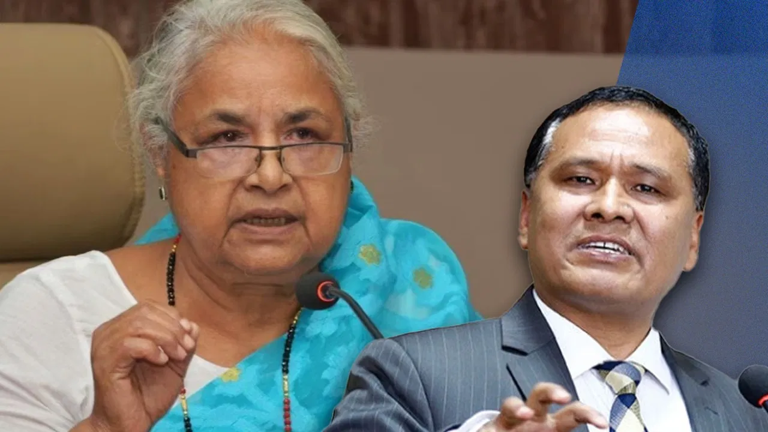

When the Sushila Karki government was formed on September 12 in the aftermath of the Gen Z protests, its stated aim was to institute a purely civilian dispensation to oversee elections to be held within six months.
Subsequently, general elections were announced for March 5. A civilian government, by definition, meant that Cabinet members would have no political affiliations.
One of the ministers appointed was Kulman Ghising, a former technocrat with known political aspirations.
When the Ujyalo Nepal Party was announced last month, it became apparent that Ghising was its brainchild. He was visibly present at the party’s inauguration and even delivered a speech, though he later distanced himself from the party.
Calls soon grew that it would be inappropriate for a “political person” to remain in a civilian government. However, as Ghising denied being a leader of Ujyalo Nepal, the concerns subsided.
That changed after Rastriya Swatantra Party (RSP) chair Rabi Lamichhane was released on bail, following which rumours began circulating that Ghising, along with Balendra Shah, would join the party.
After days of hours-long negotiations, Shah joined the RSP on the condition that the party would make him its prime ministerial candidate. Days later, Ghising also joined the RSP as the party’s vice-president.
The seven-point deal reached between Lamichhane and Ghising was widely reported in the media.
Yet, Minister for Communications and Information Technology Jagadish Kharel said on Friday that the government has no official information about Ghising joining any party.
Speaking to journalists at Bharatpur airport, Kharel, who is also the government spokesperson, said, “The government has not received any official information about him joining any party. Once the government is formally informed, a decision will be taken accordingly through a Cabinet meeting.”
Kharel’s statement, however, tells only part of the story.
Prime Minister Karki is facing a moral dilemma, insiders say. Ghising had been planning to enter politics for some time—well before the Gen Z protests—and his ambitions were public knowledge.
When leadership of the government fell on Karki’s shoulders, she needed “capable hands,” and Ghising was one of them. According to government sources, Karki was fully aware of Ghising’s political ambitions but earnestly requested him to join the government, which he did.
“Now Karki believes it would be better if Ghising left the government on his own,” said a government insider. “She is under moral pressure and is in no position to ask him to step down.”
The Karki government is already under immense pressure to hold elections on time and hand over power to an elected government. It has faced criticism for failing to make public the Cabinet members’ property details, and some of its decisions—such as recalling ambassadors—have also drawn flak.
Ghising’s political alignment, and his continued presence in the Cabinet, has now become another test for Karki.
In late October, during an interaction with journalists, Karki said she had no political ambitions of her own but openly wondered about Ghising’s plans. While Finance Minister Rameshore Khanal clearly shook his head in the negative, Ghising, seated next to him, dodged the question.
Thus, while Kharel’s statement that the government has no official information may be technically correct, Ghising’s presence in the Cabinet continues to place Karki on the horns of a dilemma.
NRNHub
01/02/2026 11:47 PM EST3 min read