Economy always missing from Nepal’s election agenda
Voters rarely see economic policies debated, while political theatrics dominate campaigns.

NRNHub
01/19/2026 10:22 AM EST5 min read
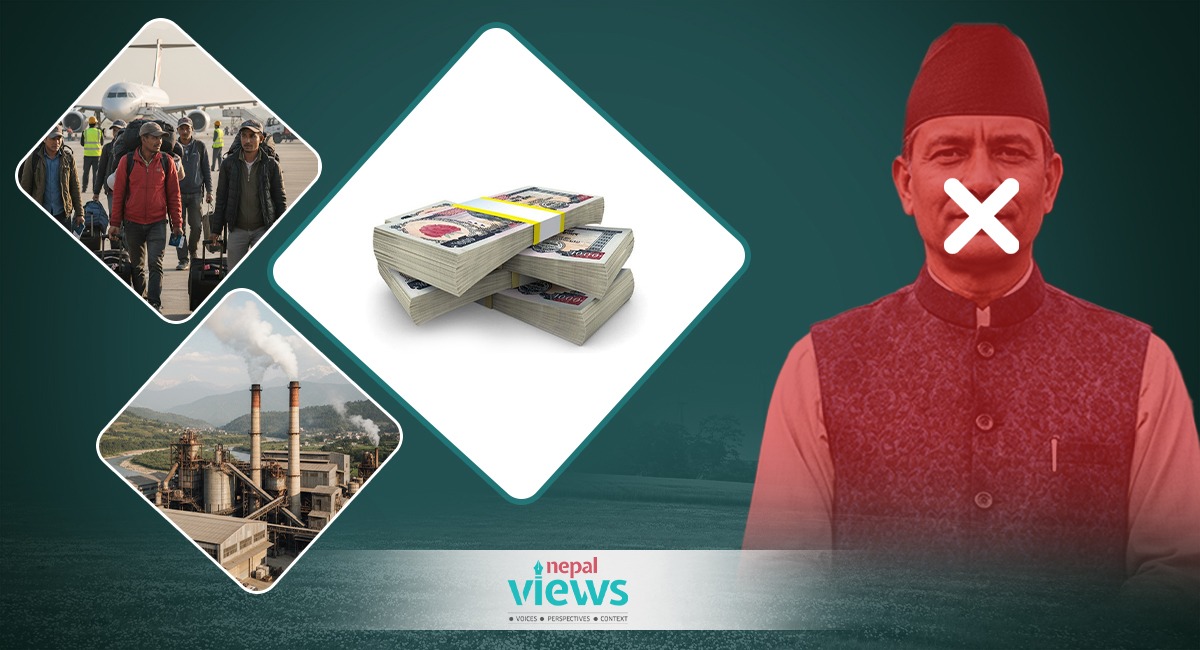

Kathmandu: In mature democracies, elections are shaped more by economic realities and less by political theatrics. Voters judge parties by how future economic policies affect their daily lives — jobs, incomes, prices, and security. When growth is steady and financial stability holds, incumbents are rewarded. When it falters, voters punish those in power. This is democratic accountability, often described as anti-incumbency.
This is the beauty of democracy and regular elections.
Nepal, however, appears to be a striking exception. Here, economic issues rarely define elections. The economy is hardly anyone’s agenda.
Instead, politics revolves around which party split or reunited, who joined which coalition, who got a ticket, who defected, and which leader insulted whom. The media recycles the same rhetoric and stale speeches, rarely pausing to examine party policies or economic plans. Media attention focuses on the frantic movements of politicians and activists. Party-hoppers are celebrated as electoral “heroes.” As a result, political manoeuvring dominates public debate, while real economic questions stay on the sidelines.
A healthy democracy needs the opposite: voters who change their choices based on issues, and parties that stand firmly by clear ideas and policies.
Nepal has neither.
A large section of voters remains loyal to “mother parties,” rarely changing allegiance regardless of performance. At the same time, political leaders shift positions opportunistically, leaving little room — or incentive — for serious discussion on economic issues.
Economic issues that should define elections
1. Private property vs socialism
Nepal’s constitution describes the country as “socialism-oriented,” and almost every major party claims to be socialist. But what does that mean in practice? No party offers a clear definition, let alone concrete plans, policies, or programmes.
Socialism is often understood vaguely — and too simplistically — as nationalisation of major means of production.
In a country where the constitution allows the state to nationalise private property, what happens to property rights? How is investment supposed to grow? Why would entrepreneurs take risks?
A decade after adopting a socialism-oriented constitution, Nepal’s economy is neither clearly socialist nor convincingly market-driven. Even leaders who call themselves socialists criticise their own governments as practising “crony capitalism.”
Elections should be the space to resolve this confusion. They are not.
2. Investment security
Every government calls for more private and foreign investment, yet undermines it in practice.
Investment summits are held with great fanfare, but the results are poor — often less than 20 percent of pledged investments materialise.
The reasons are well known: legal and administrative hurdles delay projects; weak security exposes businesses to vandalism and political unrest; and a deep suspicion of profit discourages competitiveness.
Still, no party treats investment security as a serious election issue.
3. Size of the economy
By population, geography, and resources, Nepal is a medium-sized country. Yet its economy remains small. Switzerland, with less than half Nepal’s population and land area, has an economy about 24 times larger. Singapore’s economy is roughly 70 times bigger.
These comparisons are often mentioned but rarely questioned. Why have those economies grown while Nepal’s has stagnated? Nepal’s economy is officially estimated at around Rs 6.1 trillion, though some believe the figure is inflated to make public debt appear smaller relative to GDP.
What is the plan to grow the economy? No party makes this an election issue.
4. Absolute poverty
Globally, absolute poverty is declining. China claims to have eliminated it; India reports rates below 5 percent. Nepal, however, is moving in the opposite direction. Absolute poverty, estimated at 18.5 percent before COVID-19, has reportedly risen to around 25 percent — meaning about 7.5 million people live below the poverty line.
This should be politically explosive. Instead, it barely registers. Parties ignore it, leaders avoid it, and voters are not encouraged to think about it before voting.
5. Budget structure
The structure of the national budget should be central to election debates. What will a party prioritise? Which sectors will gain or lose funding? What is the development strategy? How will social security be financed? Will administrative costs be reduced — and how?
Yet Nepal’s budget structure has barely changed in decades: around 75 percent current expenditure, 15 percent financing, and only about 10 percent capital spending. Is this sustainable?
On top of that, Nepal’s budgets are highly repetitive. Most governments simply reproduce previous budgets with a few cosmetic changes. Anyone who follows the budget closely knows it is largely copy-paste, with minor tweaks.
Who has the plan — and the courage — to break this pattern? Elections offer no answer.
6. Tax system
Taxes affect voters directly, yet tax policy is largely absent from political debate. Nepal has around 42 types of taxes, many of them unnecessary or poorly designed. Several tax laws exist only on paper.
Policy mistakes have slowed entire sectors. Capital gains tax on land transactions, for instance, led to an estimated 80 percent drop in deals.
Still, no party treats tax reform as an election priority.
7. Public debt
Public debt should be among the most debated election issues. Is it rising or falling? Why? How is the money being spent? Who is responsible?
Since the 2015 constitution, public debt has jumped from about Rs 7 trillion (28 percent of GDP) to roughly Rs 29 trillion (around 48 percent of GDP). Interest payments now take up 15–20 percent of the annual budget. Yet debt remains politically invisible.
8. Foreign employment and migration
Leaders often lament the number of people leaving the country for work. We know how many leave each day — and how many return in coffins. What we don’t hear is how different parties would change this reality.
Migration policy should clearly separate political choices. It does not.
9. Unemployment and low income
Financial exploitation — loan-sharking, cooperative fraud, and similar scams — is becoming normalised. State response has been weak, and in some cases even lenient. More than three million people have been affected.
In such a situation, whom should voters trust? No party gives a convincing answer.
These are not abstract concerns. They directly shape people’s lives and futures. Yet they remain largely absent from Nepal’s electoral discourse.
Until voters demand clear answers — and parties are forced to provide them — elections will continue to revolve around personalities and power games, not policy or performance.
NRNHub
01/19/2026 10:22 AM EST5 min read