Oli asserts Lipulek claim to Xi, says Nepal has lodged strong objection to India-China deal
China’s Ministry of Foreign Affairs does not mention Lipulekh discussion during meeting between Nepali and Chinese leaders

NRNHub
08/30/2025 12:57 PM EDT4 min read
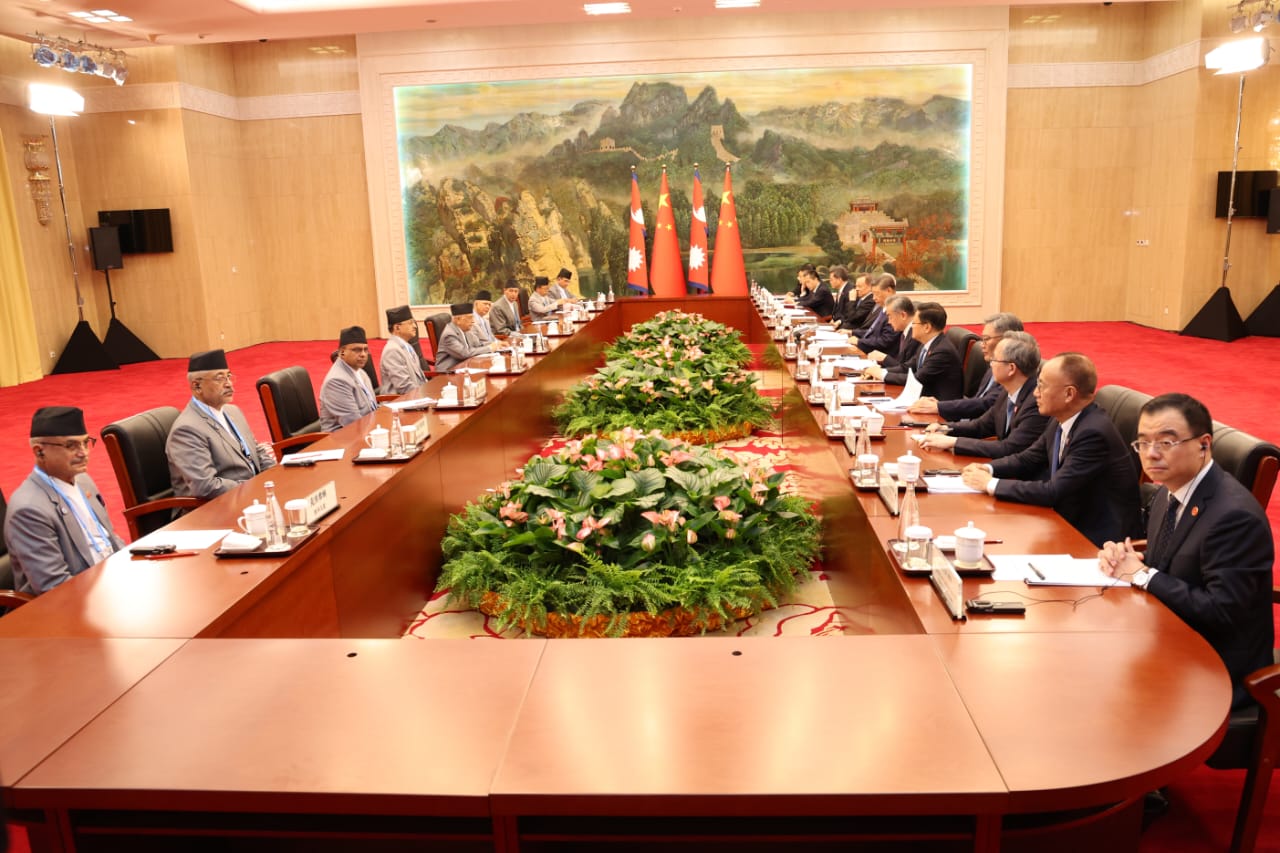

Kathmandu: Prime Minister KP Sharma Oli conveyed to Chinese President Xi Jinping that Lipulekh belongs to Nepal.
Oli held bilateral talks with Xi in Tianjin, China, on Saturday.
A statement issued by the Embassy of Nepal in Beijing said: “Referring to the recent understanding reached between India and China on border trade through the Lipulekh Pass, Prime Minister Oli stated that the territory belongs to Nepal and that the Government of Nepal has registered its strong objection to the same.”
The statement implies that while Oli asserted Lipulekh as Nepal’s territory, he did not make a new, direct, or active objection. Instead, he referenced previous objections made via diplomatic notes sent in 2015 and recently.
Prime Minister Oli, who arrived in China on Saturday for the Shanghai Cooperation Organization (SCO) Summit, held a bilateral meeting with President Xi shortly after his arrival.
Recently, China and India reached an agreement regarding the operation of the Lipulekh pass, which has sparked widespread opposition in Nepal. Furthermore, Nepal has sent diplomatic notes to both India and China regarding the issue, according to officials at the Ministry of Foreign Affairs. However, the Ministry has not officially commented on the matter.
The embassy's Saturday statement does not mention Xi's response.
Foreign Secretary Amrit Bahadur Rai, who was present during the meeting between Oli and Xi, said Prime Minister Oli reminded President Xi that, according to the Sugauli Treaty, Lipulek is Nepali territory and expressed clear disagreement with the China-India agreement.
“During the talks, the Prime Minister raised the issue of Lipulekh. Specifically, he pointed out that the Sugauli Treaty of 1816 defines Nepal’s borders. According to this treaty, all territories east of the Mahakali River are Nepali territory — sovereign Nepali territory,” Rai said. “The agreement that allows the use of Lipulekh as a trade route should not have been made, and China should not adhere to it. Nepal has objections to that agreement.”
According to Rai, in response, the Chinese President said: “Lipulekh is a traditional border pass, and an agreement has been made to operate it accordingly. There is no shortcoming in Nepal's claim, and since the border dispute is a bilateral issue [between India and Nepal], it is something for the two sides to resolve. Please understand this in that context.”
A statement from China’s Ministry of Foreign Affairs, however, does not mention the Lipulekh discussion during the meeting between Oli and Xi.
“President Xi noted that China and Nepal are neighbours linked by mountains and rivers and enjoy a lasting friendship. The two are also peace-loving countries who stand on their own feet,” the Chinese statement said. “China and Nepal are now making steady progress in high-quality Belt and Road cooperation, and the two peoples have forged a closer bond with each other.”
The statement quoted Oli as saying, “The Nepal-China relationship, having stood many tests, has only grown stronger. Nepal is committed to achieving continuous development and looks forward to deepening cooperation with China in the context of the Belt and Road Initiative.”
According to the Nepali embassy, during the meeting, Prime Minister Oli expressed hope for the acceleration of projects already agreed upon, including those under the BRI.
“He requested support in areas such as fertilizer, petroleum exploration, human resources development, climate resilience, and people-to-people connections,” the statement read.
President Xi expressed China’s willingness to support Nepal in fulfilling its aspiration of a “Prosperous Nepal, Happy Nepali,” the embassy said.
“He also stated that China will cooperate with Nepal in multilateral forums, including the United Nations and the SCO. The President of China thanked Nepal for its strong adherence to the One China Principle and reiterated China’s continued support for Nepal’s development, including through the implementation of high-quality Belt and Road Initiative projects that have been agreed upon by both countries,” the statement said.
The meeting between Prime Minister Oli, who is in China representing Nepal as a dialogue partner at the SCO summit, and Chinese President Xi took place shortly after the China-India agreement on the Lipulekh trade route.
Following the SCO summit, Prime Minister Oli will visit Beijing, where he is scheduled to participate in China’s Victory Day Parade. While in China, Prime Minister Oli is also scheduled to meet with other heads of state, including Russian President Vladimir Putin, as part of his official engagements.
Nepali version of the news story
Related News:
NRNHub
08/30/2025 12:57 PM EDT4 min read